Every options trader has watched it happen: the index drifts all afternoon, and by the last half hour it is sitting on a round strike as if someone had parked it there. Nobody parked it. Option dealers who sold that strike’s calls and puts had to hedge as price moved, and near expiry the hedging around a heavily-written strike gets strong enough to pull price toward it and hold it. Traders call the strike a pin. The trouble has always been knowing, at eleven in the morning, whether today’s pin is real.
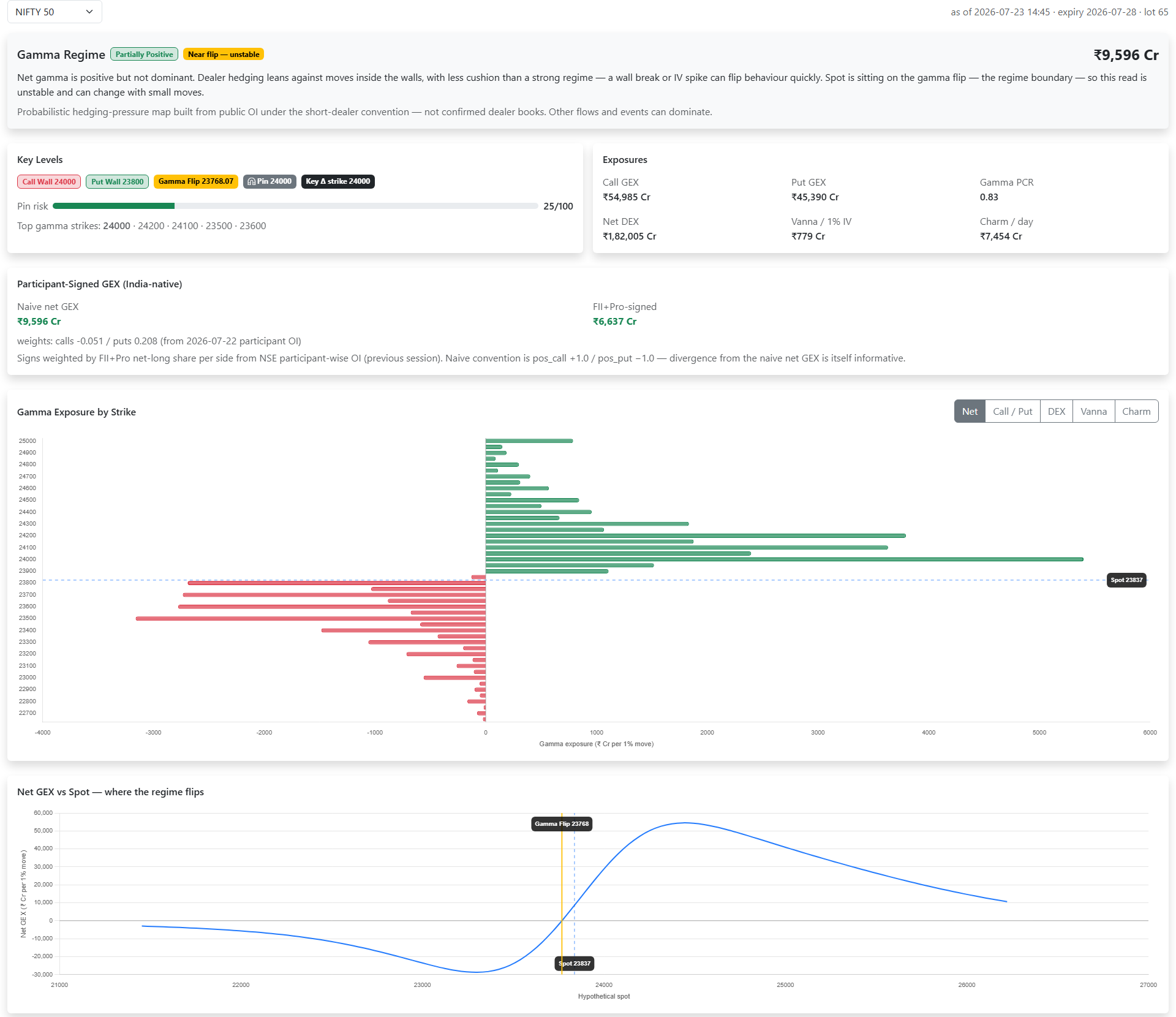
Pin conviction is a number for exactly that question. It lives on the Dealer Positioning page, updates every minute through the session, and reads out in plain words: which strike is pulling, how hard, and whether the read is forming, weak, stable or locked.
What pin conviction measures
Start with the gamma at each strike. Gamma (the standard definition) is how fast a dealer’s hedge must change as the index moves, so a strike with a lot of open interest and a lot of gamma is a strike where hedging flows are concentrated. That is the raw material. On its own it is not enough: a heavy strike three hundred points away is not pulling anything today.
So the score weighs each strike’s gamma by how far it sits from spot, using the market’s own yardstick for a normal move: the price of the at-the-money straddle, which is what the market charges for all the movement left until expiry. A strike inside one straddle-width of spot counts nearly in full; a strike three straddle-widths away barely counts. As expiry approaches the straddle shrinks, the window tightens, and the same gamma at the same strike pulls harder. A time amplifier adds a little more weight in the final hours, because that is when the mechanics dominate everything else.
The strike with the most weighted pressure is the pin. The page shows the five strongest candidates as a percentage of the leader, so you can see at a glance whether one strike dominates or two are fighting for the job.
The score
Three things decide the number from zero to one hundred.
- How much of the pressure the leader carries. A strike holding forty percent of the weighted gamma near spot is a magnet; one holding fifteen percent is a suggestion.
- Its lead over the runner-up. If the second strike carries almost as much, price can settle at either, and the read is a zone, not a level.
- How close spot already sits to it. A pin two hundred points away has to win a tug of war first.
The raw number jumps around from minute to minute as open interest changes, so the page smooths it while the same strike keeps the lead and resets it the moment a different strike takes over. That is deliberate: a pin that changes strike is not a pin yet.
The pin conviction states
The number is useful, but the state is what you act on. The pin conviction rules are simple and they are about time as much as size.
- No pin. The score is under thirty, or the chain is too thin to say anything. Flow, not gamma, is running the tape.
- Shifting. The leader has no clear margin over the runner-up, or the leading strike keeps changing. Treat the pin as a zone.
- Forming. A strike has taken the lead within the last few minutes. Real, but not yet trusted.
- Weak. The strike has held the lead for a while, but the pull is mild. A bias, not a magnet.
- Stable. The strike has held the lead for several minutes with a clear margin and a score above sixty. A real pin.
- Locked. The same strike has led for half an hour with a wide margin and a score above eighty. This is the expiry-afternoon magnet.
The page also keeps a tally you cannot argue with: on how many stored sessions did the pin read at 15:00 hold into the close within a quarter of a percent. It starts small and grows one session a day. When we replayed the first twelve stored NIFTY sessions through the engine, the two expiry days both closed within that band of the afternoon pin; the ordinary days, as you would expect, were a coin flip at best. That is the point of the states: they tell you which days the read deserves your attention.
How to use it
Read the pin conviction state before the number, then check three things around it on the Dealer Positioning page. On expiry day the Expiry Day page draws the same pin as a funnel: the expected-move band narrowing onto the magnet through the session.
- Where spot sits in the corridor. The put wall is the floor, the call wall the ceiling. A stable pin inside a tight corridor is the calmest tape there is; a pin sitting on a wall with spot on the wrong side of the flip is a pin about to be tested (the flip itself is explained in the gamma flip level and pin risk).
- How packed the gamma is. When gamma sits in a few strikes the levels are sharp and the pin is worth trading against. When it is spread out, use the corridor as a zone instead.
- The hedge ladder. It shows how much the desk must buy or sell if spot moves to each price step. A locked pin with small hedge sizes on both sides is a pin nobody has to fight; a pin with a jump in the ladder just above it is a pin that becomes a breakout if price gets through.
On the timeline below the cockpit you can watch the state change through the day and click any minute to replay what the page said at the time. That is the fastest way to learn what a forming pin looked like an hour before it locked.
Where it fails
Three honest limits. Pin conviction is computed from public open interest under an assumption about who holds the other side, so it is hedging pressure, not dealer inventory. A large event, an index rebalance, or a sudden burst of new writing can move the pin in a minute, which is why the states demand hold time. And on expiry day the straddle collapses in the final hour, so the window around spot becomes very narrow: the last-hour pin is usually right, but it is also usually already where price is.
Used with those limits in mind, pin conviction replaces a feeling with a read you can check, on the Dealer Positioning page, every minute of the session.