Two stocks can have identical charts and behave nothing alike. One grinds within its range all day and mean-reverts off every extension; the other gaps, trends, and runs stops. A large part of that difference is whether option hedging in that name is absorbing moves or chasing them — and the names where it chases are the short gamma ones.
On the indices you watch that condition on one screen. Across two hundred F&O stocks you need a screener.
What short gamma means for a single stock
The mechanics are the same as on the index, just smaller. Whoever is short options must hedge in the direction of the move: buy as it rises, sell as it falls. That hedging adds to whatever the market is already doing. Whoever is long options hedges against the move and absorbs it.
Net gamma exposure aggregates that across a stock’s whole chain and nets the call side against the put side. When the total comes out negative, the name is in short gamma territory: hedging flows amplify. When positive, they dampen.
Two columns carry that read:
- Net GEX ₹ Cr — the rupee size of the hedging that has to happen per 1% move in the stock. Signed, so negative means short gamma.
- Net ratio — net GEX divided by gross gamma exposure, which strips out size. A ₹5 Cr net on a ₹10 Cr book is a far more decisive read than a ₹5 Cr net on a ₹500 Cr book, and the ratio is what makes SUNPHARMA at 0.38 comparable to AMBER at −0.34 despite very different notional.
Read the ratio for conviction and the rupee figure for how much flow is actually involved. A small-cap with a decisive negative ratio and ₹2 Cr of net GEX will not move on hedging alone; there simply is not enough of it.
Reading the screener
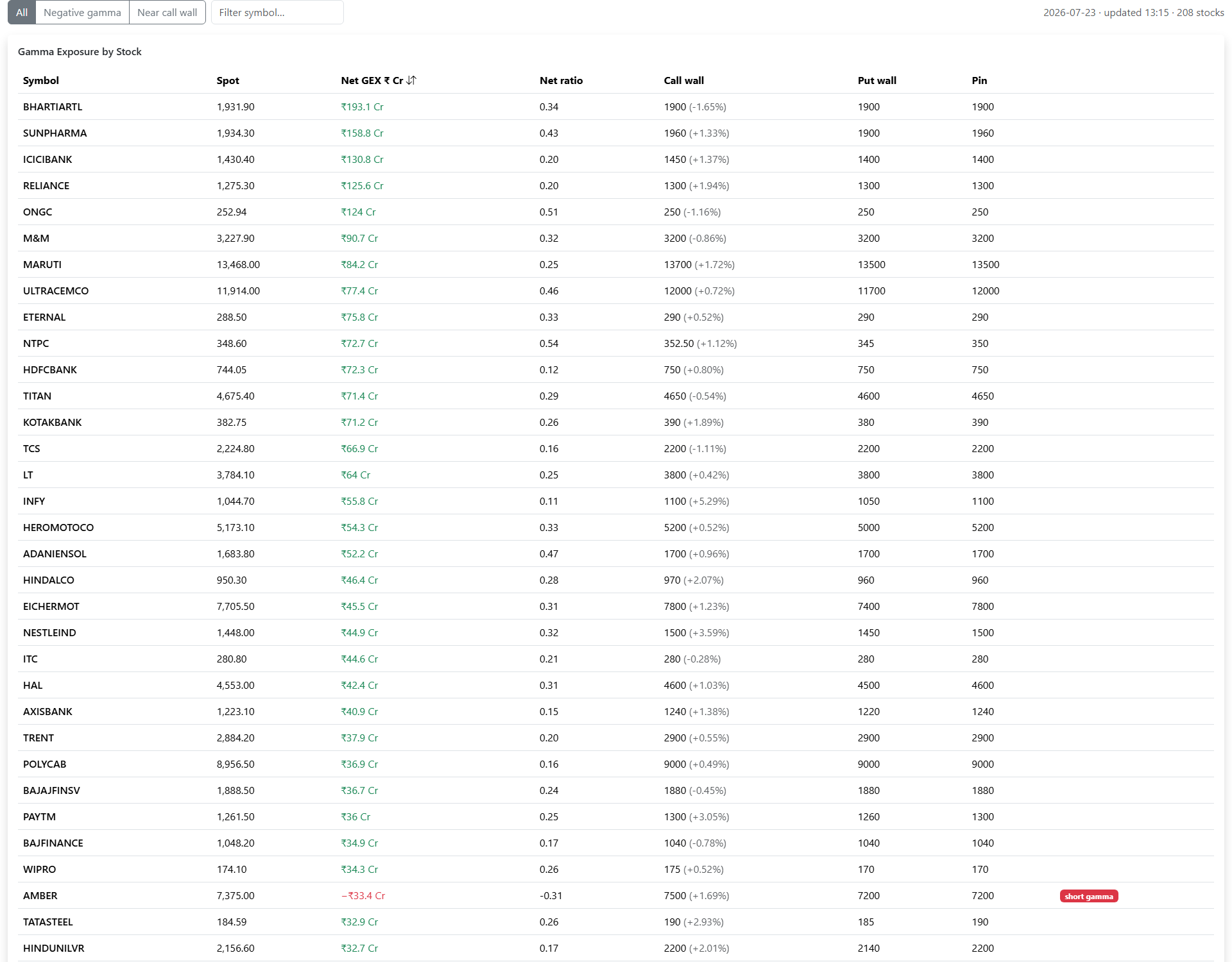
The default sort is by absolute net GEX, so the names carrying the most hedging pressure — either sign — come first. Clicking the Net GEX header switches to a signed sort, which is how you get the most negative names to the top.
Three filters do most of the work:
All is the full sweep — 208 stocks in the screenshot, stamped with the date and the last refresh time.
Negative gamma narrows to the short gamma names directly. In the screenshot that is a short list: AMBER at −₹50.6 Cr and BAJAJ-AUTO at −₹37 Cr against a large majority of positive-gamma names. That asymmetry is normal, and it is worth internalising — most F&O stocks most of the time sit in positive gamma, which is exactly why the negative ones are worth a dedicated filter.
Near call wall keeps only names trading within 1% of their call wall. This is the filter that finds setups rather than conditions, and it is covered below.
Alongside those sit the three levels per stock:
- Call wall — the strike with the largest call-side gamma, with its distance from spot in brackets. SUNPHARMA at 1,941.10 against a 1960 call wall is +0.97% away.
- Put wall — the largest put-side gamma concentration.
- Pin — the strike spot is most likely to be held near into expiry.
Note how often the pin and the call wall coincide in the screenshot — 1960 for SUNPHARMA, 250 for ONGC, 280 for ITC. On single stocks with a coarse strike ladder, gamma concentrates into very few strikes, so the levels stack up far more than they do on NIFTY.
The two setups this screen actually finds
A short gamma name approaching its wall. This is the combination worth waiting for. Negative net GEX means hedging chases; the call wall is where hedging is thickest. A stock in short gamma pressing into its call wall is a name where a break can move much further and faster than the chart suggests, because the hedging that would normally cap it is pushing the other way. AMBER in the screenshot is 0.48% under a 7300 call wall with a −0.34 net ratio, which is precisely that shape.
A positive-gamma name pinned at its wall. The inverse, and more common. Heavy positive gamma with spot sitting on the pin strike is a name likely to go nowhere into expiry — useful if you write premium, and a warning if you are paying for movement.
The Near call wall filter exists for the first case. Run it, then read the sign of the net ratio on whatever it returns: near the wall with positive gamma is a fade, near the wall with short gamma is a break risk.
Limits worth knowing
It is a sweep, not a live feed. The screener runs periodically through the session — the screenshot is stamped 03:06 pm — and the first sweep lands shortly after 10:05 IST. Index dealer positioning updates every minute; this does not, because it is recomputing the full chain for two hundred names.
Single-stock chains are thin. Fewer strikes, wider spacing and patchier greeks than an index chain. A stock’s gamma profile can be dominated by two or three strikes, which makes the walls sharper but also more fragile — one strike unwinding relocates the whole picture.
Stock options are less hedged than index options. A meaningful share of single-stock option volume is positional rather than delta-hedged, so hedging flow is a weaker force here than on NIFTY. Treat the read as softer.
The sign convention still applies. As with any GEX model, public open interest does not reveal who is long, so call gamma is signed positive and put gamma negative by convention. The index page offers a participant-signed cross-check; the stock sweep does not. For the option-level maths underneath all of this, Investopedia’s gamma explainer is a good primer.
Earnings override it. A stock into results will do what the results say, regardless of where its gamma sits.
On OIData
The GEX Screener sweeps every F&O stock for net GEX, net ratio, both walls, the pin strike and distance to the call wall, with the negative-gamma and near-wall filters and a symbol search. For the same read on the indices — plus the gamma flip, pin risk, per-strike profile and participant-signed check — use Dealer Positioning. To see what the futures book is doing in the same names, the Screener ranks them by buildup.
Takeaways
- Short gamma means option hedging amplifies moves instead of absorbing them; negative net GEX flags it.
- Read the net ratio for conviction and net GEX in ₹ Cr for whether the flow is big enough to matter.
- Most F&O stocks sit in positive gamma most of the time, which is why the negative filter is useful.
- The setup worth hunting is a short gamma name pressing into its call wall.
- Single-stock gamma is thinner, less hedged and slower-updating than index gamma — size accordingly.