From Monday, 7 September 2026, the first fifteen minutes of the Indian trading day change shape. The 09:00–09:15 pre-open on NSE and BSE becomes an open auction session built on the same rules as the closing auction that arrived in August: market orders only in the first five minutes, a random close between 09:08 and 09:10, and a matching window at 09:10 that sets every stock’s opening price. The 09:15 bell does not move. What moves is how the opening price is made — and, more importantly, what it now has to answer.
What the open auction session is
The pre-open call auction is not new. Since 2010 the NSE has collected orders from 09:00, closed the book at a random moment between 09:07 and 09:08, and matched everything at one equilibrium price per stock before continuous trading starts at 09:15. In December 2025 the same mechanism was extended to index and stock futures.
SEBI’s circular of 16 January 2026 — the one that introduced the Closing Auction Session (CAS) — also rewrote that pre-open framework so the two ends of the day work the same way. The new session, effective 7 September 2026 for both the cash and the equity derivatives segments, runs like this:
| Time (IST) | What happens | Orders |
|---|---|---|
| 09:00–09:05 | Order entry | Market and limit orders can be placed, modified or cancelled |
| 09:05–09:10 | Order entry, limit orders only | Market orders are locked: no new ones, no changes, no cancellations. The book closes at a random, system-driven moment between 09:08 and 09:10 |
| 09:10–09:12 | Matching | One equilibrium price per stock; market orders match first, then limit orders in price-time priority |
| 09:12–09:15 | Transition | Orders move into the continuous session; the index open is built from the auction prices |
| 09:15 | Bell | Continuous trading begins |
Three things are genuinely different from the old session. Market orders are confined to the first five minutes and cannot be touched afterwards. Limit-order entry runs about two minutes longer, with the random close moved to 09:08–09:10. And market orders now take priority over limit orders when the book is matched — the reverse of the old rule. Everything else — full-quantity disclosure, no stop-loss orders, one price per stock — carries over.
BSE goes live the same day: SEBI set one date for every exchange, and BSE issued its own notices (20260803-35 for equity, 20260803-36 for derivatives). So SENSEX and BANKEX open under the new rules alongside NIFTY.
Why this is more than a timing tweak
On its own, a later random close and a market-order cutoff would be a footnote. The reason the open auction session matters is what happened at the other end of the day a month earlier.
Since 3 August 2026 the official closing price has been set by the Closing Auction Session. The index feed freezes at 15:15, orders are collected in the dark, and the auction’s equilibrium reprints the index in one step near 15:28. In the first sessions that print landed a long way from where the market was actually trading: NIFTY closed +200.95 points above the frozen tape on day one, above the entire day’s range, while futures — which kept trading to 15:40 — implied a cash level roughly 180 points lower. The next morning the index opened within a few points of what futures had said, and the print was gone.
That pattern turns every open into a verdict. The previous close is an auction price; the open is now an auction price too; and in between sits the futures market’s opinion of what the index was really worth. A “gap down” of 150 points against the official close can be a flat open against the futures view. Anyone running gap screeners, opening-range setups or overnight pivots off the official close is measuring the auction, not the market.
What to watch from 09:00
Yesterday’s auction close next to futures-implied cash. The futures price at the close minus the day’s normal basis is where the derivatives market said the index belonged. The distance between that and the official close is the argument the open has to settle.
The indicative index. SEBI requires exchanges to publish an indicative index while auction orders are collected. Whether a given data feed relays it is an empirical question — during the closing auction the same feeds simply held the last value — so the first mornings will show which vendors carry the auction forming and which show the previous close until 09:15.
The opening print, measured three ways. Against the official close (the number every gap screener uses), against futures-implied cash, and against the last continuous price before yesterday’s freeze. When the three disagree, the smallest of them is usually the honest gap.
The first fifteen minutes. Whether the opening gap holds or is given back by 09:30 is the oldest statistic in day trading, and the open auction session gives it a cleaner starting point: one auction price at 09:15 instead of a scramble of first ticks.
How we track it
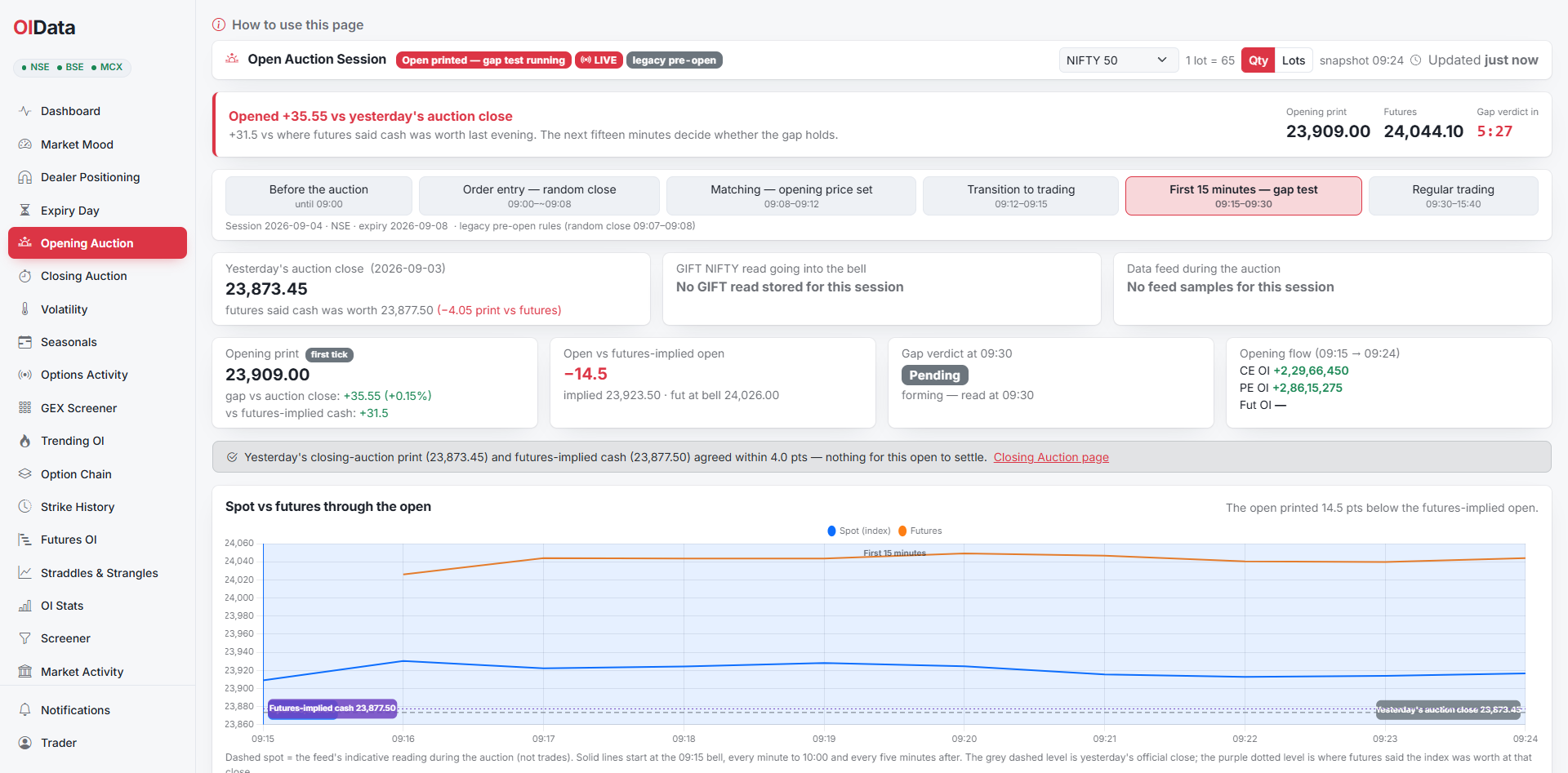
The Opening Auction tracker on OIData follows every session live from 08:55: a phase strip and countdown through order entry, the random-close window and matching; yesterday’s auction close beside futures-implied cash and the GIFT NIFTY read; the data feed’s own view of the auction, sampled every thirty seconds; and, at the bell, the opening print measured against all of them. At 09:30 it records whether the gap held or faded, and every session adds a row to the history — including whether the previous afternoon’s closing print faded at that open, the same verdict the Closing Auction tracker keeps from the other side. NIFTY, BANKNIFTY, FINNIFTY, MIDCPNIFTY, SENSEX and BANKEX share one index switcher.
Both ends of the day are auctions now. The number that ends one session and the number that starts the next are each the output of a book most feeds cannot see into, and the market that trades continuously in between — futures — is the only witness to both. The open auction session is where it gives evidence every morning at 09:15.