If options open interest is rich but complicated (every strike, buyers and writers), futures contracts offer a much cleaner alternative. A futures long is a long and a short is a short — there is no writing-versus-buying ambiguity. That makes futures the best place to read directional positioning, and it’s where the classic buildup signals work most cleanly. Read futures open interest well and you can tell whether large players are building fresh longs or pressing shorts. Understanding how to track these changes systematically helps you filter out market noise and align with the dominant trend. Here is a practical guide to using futures open interest analysis in your daily trading routine.
Why futures open interest is the cleanest read
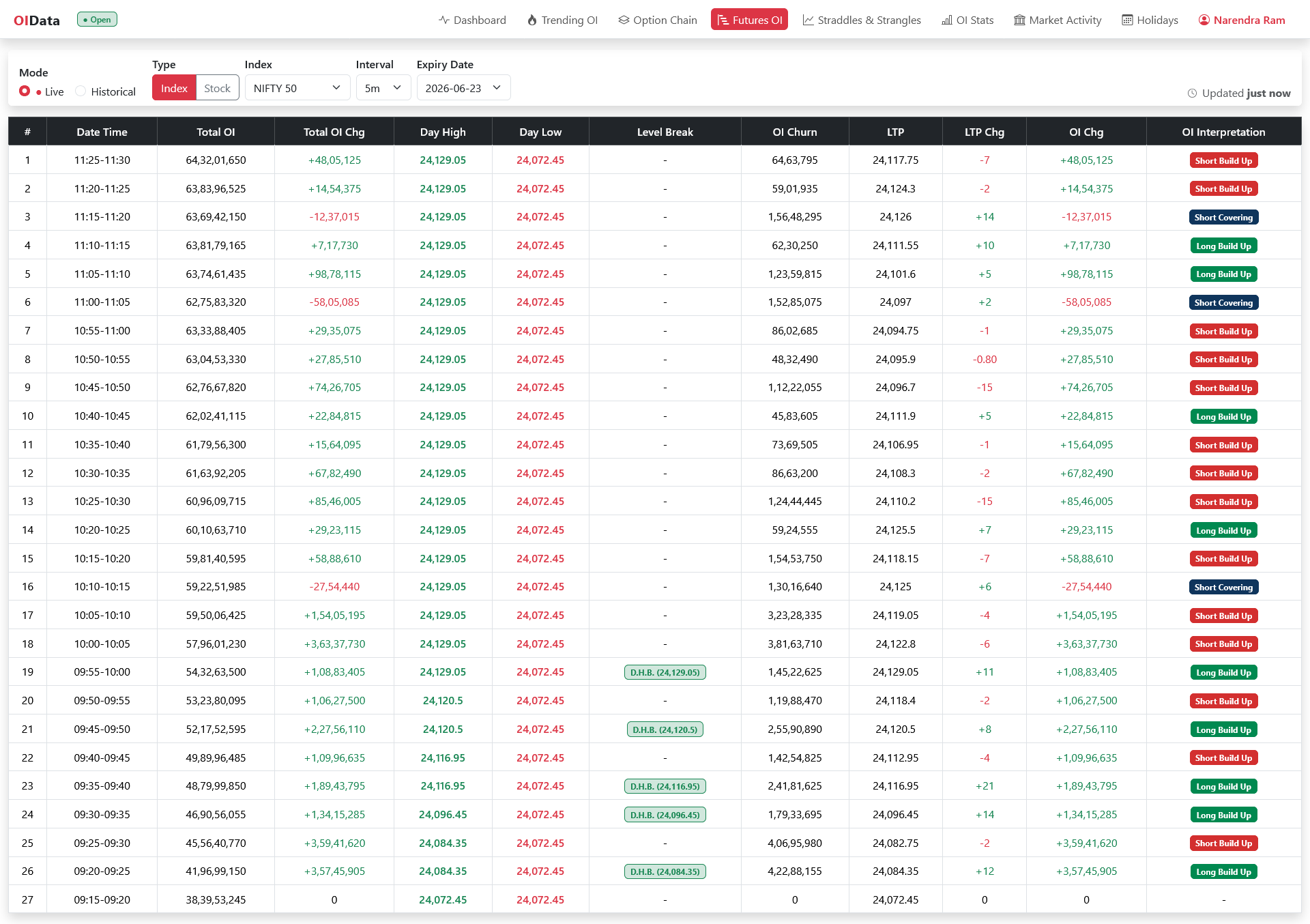
On the option chain, rising OI could mean buying or writing, so you have to check the option’s price to interpret it. Futures have no such ambiguity: open interest simply reflects how many futures contracts are open, and price tells you which way they’re leaning. That’s why the four buildup signals — long buildup, short buildup, short covering, long unwinding — are at their most reliable on futures.
Quick recap of the combinations:
| Price | Futures OI | Signal | Bias |
|---|---|---|---|
| Up | Up | Long buildup | Bullish |
| Down | Up | Short buildup | Bearish |
| Up | Down | Short covering | Bullish (often temporary) |
| Down | Down | Long unwinding | Bearish (often weakening) |
A NIFTY future rising on rising OI is new longs; a stock future falling on rising OI is fresh shorts. Pair it with volume for confirmation and you have a high-quality trend read.
Combining OI with volume
Never read open interest in isolation. Volume acts as the validation engine for OI changes. While open interest tells us the number of active contracts carried over, volume tells us the intensity of trading activity during a single session.
For instance, if you see a sharp rise in open interest accompanied by exceptionally high trading volume, it indicates high-conviction participation from large institutional players. Conversely, if open interest rises on thin volume, the buildup might lack the momentum needed to sustain a breakout. According to Investopedia’s guide on open interest, volume precedes price, and combining it with open interest changes provides a multi-dimensional view of market liquidity and participant commitment.
Look for days where both volume and OI sit above their 10-day averages. These are the days when true institutional positioning is established, offering high-probability setups for retail traders.
Reading the basis (futures vs spot)
Futures rarely trade exactly at the spot price. The difference is the basis:
Basis = Futures price − Spot price
In normal conditions, index futures trade at a small premium to spot, reflecting the cost of carry (the financing cost of holding the position, net of dividends). How the basis behaves is informative:
- Widening premium alongside rising price and OI → confident bullish carry.
- Premium shrinking, or futures slipping to a discount → traders are unwilling to pay up to be long; often a cautious or bearish tell.
- Persistent discount can signal hedging pressure or bearish positioning.
The basis is a sentiment nuance on top of the buildup read, not a standalone signal.
The Role of FII and DII Data
In the Indian context, retail traders are often on the opposite side of institutional giants like Foreign Institutional Investors (FIIs) and Domestic Institutional Investors (DIIs). So cross-reference aggregate OI changes against participant-wise data.
The National Stock Exchange of India (NSE India) publishes daily participant-wise open interest reports. By analyzing this data, you can see whether the “long buildup” in Nifty futures is being driven by aggressive FII buying or retail speculation. If FIIs are adding heavy longs while proprietary desks are writing calls, the bullish bias has strong institutional backing. On the other hand, if a rise in futures open interest is purely driven by retail clients going long while institutions are building short positions, the rally might be on shaky ground. To understand this dynamic deeper, read our guide on Pro vs Client Positioning and learn how to decode FII & DII Data.
Rollovers: reading the expiry handover
As a contract nears expiry, traders either close out or roll over — carry their position to the next series. Rollover behaviour is a useful gauge of conviction:
- Rollover percentage — roughly, how much of the expiring open interest is carried forward to the next series. High rollover means the crowd is carrying its view forward rather than stepping aside.
- Rollover + direction. Heavy rollover of longs into the new series (with price firm) suggests bullish conviction is being carried forward; heavy rollover of shorts suggests the bearish view persists.
- Rollover cost. The price traders pay to roll (linked to the basis) hints at how eager they are to maintain the position.
Around expiry, remember that OI in the expiring series collapses to zero mechanically — don’t mistake routine expiry unwinding for a fresh directional signal. Shift your attention to the building OI in the next series.
Index futures vs stock futures
- Index futures (NIFTY, BANK NIFTY) reflect broad market positioning and are where institutional and FII directional bets show up most clearly. Their participant-wise positioning is worth cross-checking — see Pro vs Client positioning.
- Stock futures reflect single-name conviction. A stock breaking out on a strong long buildup in its futures is a classic momentum setup; a sharp short buildup can precede continued weakness.
Common pitfalls
While futures open interest is cleaner than options OI, traders still fall into common traps. Here are three pitfalls to avoid:
- Confusing Intraday Spikes with EOD Conviction: Intraday OI fluctuates wildly as day traders enter and exit positions. A massive spike at 11:00 AM might completely unwind by 3:30 PM. Always rely on End-of-Day (EOD) data for structural trend analysis. For more on this, check out 10 Common Mistakes When Reading Open Interest.
- Ignoring the Expiry Cycle: In the final week of the monthly expiry, the front-month contract’s OI will drop rapidly. This is not “long unwinding” or “short covering”—it is simply the mechanical closing of contracts. To avoid false signals, switch to the next-month contract, or track the cumulative OI of the near and next month together.
- Trading OI Without Price Confirmation: Open interest is a measure of participation, not a directional indicator on its own. High open interest at a key resistance level doesn’t mean a breakout is guaranteed; you must wait for price action to confirm the move.
A practical routine
- Note price direction over your timeframe (day, week, intraday bars).
- Check the change in futures open interest — rising or falling? That gives you the buildup signal.
- Glance at the basis — is the premium expanding or compressing? Does it agree with the buildup?
- Near expiry, watch rollovers — is the position being carried forward, and in which direction?
- Confirm with volume and levels before acting. OI describes positioning; price and risk management decide the trade.
Caveats
- End-of-day is authoritative. Intraday OI is a live hint; the EOD figure is the clean record.
- Expiry distorts OI — account for the mechanical collapse and rollover.
- A signal is context, not a system. A long buildup tells you new money is long; it doesn’t tell you the stop or the target.
On OIData
The Futures OI page is built for exactly this workflow — price alongside change-in-OI so the buildup signals are obvious — and Trending OI highlights the strongest futures buildups across instruments. The Dashboard ties it together with the rest of the day’s positioning.
Session totals and OI in lots
Two additions worth knowing about. The Futures OI page now keeps cumulative session totals above the interval table — how much futures open interest the day has put into long build-up, short build-up, short covering and long unwinding, each bucket’s share of the session, and a net read of the whole day through the same OI-versus-price lens as each bar. The first bar is excluded, because its change is the overnight gap rather than intraday positioning. And every OI quantity on the page can be shown in lots instead of raw units — always the instrument’s current lot size, never a hardcoded one — with the exact quantity a hover away. Together they answer the question this guide keeps circling: who is building positions and who is exiting, without reading every row. See it live.
Related reading
To run this same futures open interest read across the whole F&O universe at once rather than one symbol at a time, see screening stocks for long and short buildup. For futures open interest on the index side, NIFTY vs BANK NIFTY covers how the two behave differently.
Takeaways
- Futures OI is the cleanest directional read — no buying-vs-writing ambiguity — so the buildup signals work best here.
- Read the basis (futures − spot): an expanding premium is confident bullish carry; a shrinking premium or discount is cautious/bearish.
- Around expiry, watch rollovers to see whether conviction is carried forward, and ignore the mechanical OI collapse in the expiring series.
- Always confirm with volume, levels and price — OI is context, not a trade.