Trading derivatives in India starts with the options terminology. This specialized vocabulary can seem intimidating at first, but half the battle for a new trader is simply decoding the everyday options terminology used on trading desks. This comprehensive guide defines the essential futures and options terminology you will encounter most often on the option chain, in market reports, and during open-interest analysis—all explained in plain, simple English. Whether you are analyzing NIFTY contracts or evaluating stock options, bookmark this resource for quick reference. Don’t forget to follow our integrated links to deeper, strategy-focused guides as you master the language of the markets.
Why options terminology matters
Trading derivatives on Indian exchanges like the National Stock Exchange (NSE) can be incredibly rewarding, but it is also highly leveraged. Knowing these terms before you risk capital is what prevents costly execution errors. For example, confusing “volume” with “open interest” is a classic beginner mistake that can lead to misinterpreting market liquidity and trend strength.
By understanding these terms, you transition from gambling on price movements to analyzing professional market positioning. Whether you are tracking retail traders or monitoring institutional moves through FII & DII data analysis, a precise vocabulary is your foundation. For verified details on market regulations, circulars, and contract specifications, you can consult the official NSE India website.
A–C
- ATM (At-the-Money) — an option whose strike is closest to the current spot price. ATM contracts are highly sensitive to price fluctuations and experience rapid time decay near expiry.
- Basis — the difference between a futures price and the spot price (futures − spot). Reflects the cost of carry; usually a small premium for index futures. Learn more about analyzing futures contracts in our Futures Open Interest Analysis Guide.
- Bid / Ask — the highest price a buyer will pay (bid) and the lowest a seller will accept (ask). The gap is the spread; wide spreads signal thin liquidity.
- Call option — the right (not obligation) to buy the underlying at the strike by expiry. Gains value as the underlying rises.
- Change in OI — the change in open interest versus the previous close. This is where fresh positioning shows up—often more useful than the raw total. Discover how to use this in 10 Common Mistakes When Reading Open Interest.
- Contract value (notional) — lot size × price; the rupee value a single contract controls.
- Cost of carry — the net cost of holding a position to expiry (financing cost minus dividends); drives the futures basis.
D–I
- Delta — how much an option’s price moves for a 1-point move in the underlying. A first-order risk “Greek” that measures price sensitivity.
- DII — Domestic Institutional Investors (such as mutual funds, insurers, and banks). See how institutional flow shapes the market in our guide on FII & DII Data Explained.
- Expiry — the date a contract settles. Indian index options have weekly and monthly expiries. Learn expiry-specific techniques in Trading Expiry Day with Open Interest.
- FII / FPI — Foreign (Portfolio) Institutional Investors — overseas money flowing in Indian markets.
- Futures — a contract to buy/sell the underlying at a set price on a future date. See Futures Open Interest Analysis.
- Gamma — how fast delta changes as the underlying moves. Highest near the strike and near expiry — the source of expiry “gamma risk.”
- GIFT Nifty — offshore NIFTY futures traded on NSE IX at GIFT City; gives a pre-market implied open cue. See our GIFT Nifty Implied Open Guide.
- India VIX — NSE’s volatility index; aggregate expected near-term NIFTY volatility. Read more about volatility on our Implied Volatility (IV) Explained page.
- Intrinsic value — the in-the-money portion of an option’s price (the rest is time value).
- ITM (In-the-Money) — a call below spot / a put above spot; it has intrinsic value.
- IV (Implied Volatility) — the market’s expected future movement, implied by the option price. See IV explained.
L–O
- Long buildup — price up + OI up: fresh longs, bullish. One of the four core buildup signals. Check out OI Buildup Explained to understand how to read these trends.
- Long unwinding — price down + OI down: longs exiting and closing out positions.
- Lot size — the fixed number of units in one contract (revised periodically by NSE).
- Margin — the capital the exchange requires to hold an F&O position (SPAN + exposure margins).
- Max Pain — the expiry strike where option buyers lose most and writers pay least. See Max Pain Theory Explained.
- OI (Open Interest) — the number of active contracts still open in the market. See What is open interest?.
- OTM (Out-of-the-Money) — a call above spot / a put below spot; pure time + volatility value.
P–S
- PCR (Put-Call Ratio) — total put OI ÷ total call OI; a sentiment gauge, often read from a contrarian perspective. See Put-Call Ratio (PCR) Explained.
- Premium — the price of an option (what the buyer pays / the writer receives).
- Pro — proprietary trading desks; watched as informed money in Pro vs Client Positioning.
- Put option — the right to sell the underlying at the strike by expiry. Gains value as the underlying falls.
- Rollover — carrying a position from the expiring series to the next month’s series by closing the current contract and opening a new one.
- Short buildup — price down + OI up: fresh shorts entering the market, bearish indicator.
- Short covering — price up + OI down: shorts buying back to exit their positions.
- Spot — the current cash-market price of the underlying index or stock.
- Square off — closing an open position completely.
- Straddle / Strangle — two-leg volatility structures (call + put) designed to benefit from large price movements or time decay. See Straddles & Strangles Guide.
- Strike — the price at which an option can be exercised.
T–W
- Theta — time decay: how much an option loses in value per day, all else equal. Accelerates rapidly as expiry approaches.
- Time value — the part of an option’s premium beyond intrinsic value; decays to zero by expiry.
- Vega — sensitivity of an option’s price to a change in implied volatility.
- Volume — contracts traded in a session (resets daily). Not the same as OI — see Open Interest vs Volume.
- Writer (seller) — the party who sells/writes an option and collects the premium, taking on the risk of obligation. Heavy writing creates the OI walls behind open interest support and resistance.
Putting the options terminology to work
Now that the terms are covered, here is how they show up in a live market. Experienced F&O traders rarely look at a single term in isolation; instead, they synthesize multiple metrics to build a high-probability trade setup.
For instance, when looking at a breakout on a stock: 1. Verify the Buildup Type: Is the price surge accompanied by rising Open Interest? A combination of price up and OI up confirms a long buildup, signaling genuine buying interest. 2. Check the Options Chain: Analyze the NIFTY & BANK NIFTY Option Chain to locate where writers are positioned. Heavy call OI acts as a ceiling, while heavy put OI acts as a floor. 3. Evaluate Volatility: Always check Implied Volatility (IV). If IV is exceptionally high, option premiums are expensive. In such high-volatility environments, non-directional strategies like straddles and strangles are often preferred over simple naked option buying. 4. Assess Overall Sentiment: Track the Put-Call Ratio to check if the market is reaching overbought or oversold extremes. Combining PCR with Max Pain can provide incredibly precise targets for expiry-day operations.
Where to go next
If you’re starting out, read What is open interest?, then How to Read the NIFTY & BANK NIFTY Option Chain, and keep this glossary open alongside the actual option chains as you practice.
On OIData
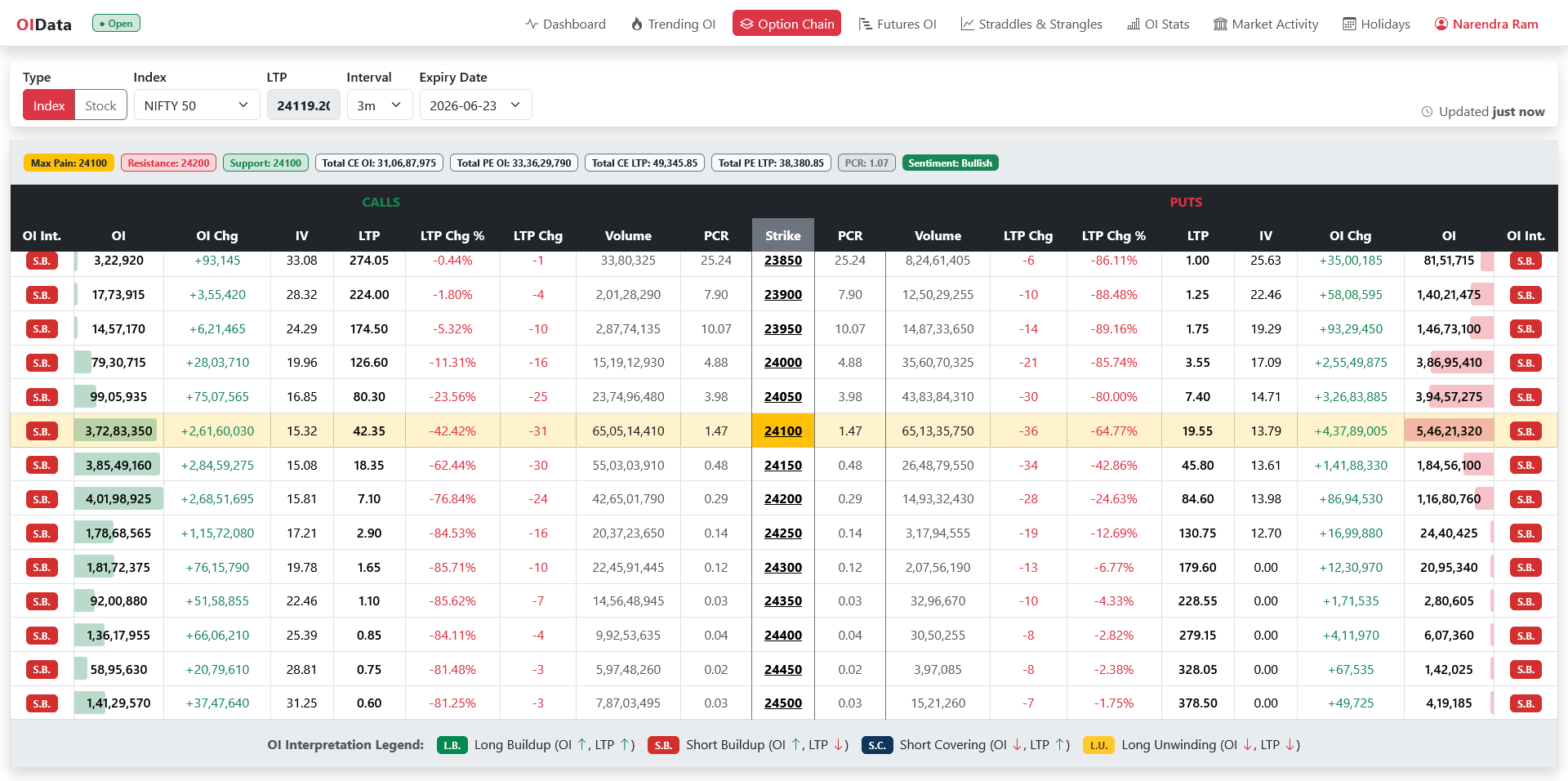
Most of this options terminology is visible in one place on the Option Chain — strike, LTP, OI, change in OI, IV, volume and PCR per strike. Futures OI carries the basis, carry and rollover terms, and Dealer Positioning the greeks beyond delta.
Takeaways
- The option chain’s core vocabulary is small once decoded: strike, premium, OI, change-in-OI, volume, IV, plus the ITM/ATM/OTM labels.
- The Greeks (delta, gamma, theta, vega) describe an option’s risks; theta and gamma matter most near expiry.
- Learn these terms once and the option chain, OI data and participant reports all become readable.
Related reading: Pro vs Client positioning puts several of these terms to work, and gamma exposure explained covers the greeks options terminology in depth.