A trading holiday looks like a non-event. For anyone holding derivatives it is not. Market holidays move expiry dates, keep charging theta while nothing trades, and — on some holidays — close clearing while leaving the market itself open. Each of those has cost real money to people who assumed a closed exchange was a neutral day.
The calendar is the easy part. Knowing what a given closure does to a position is the part worth writing down.
Not every closure is the same closure
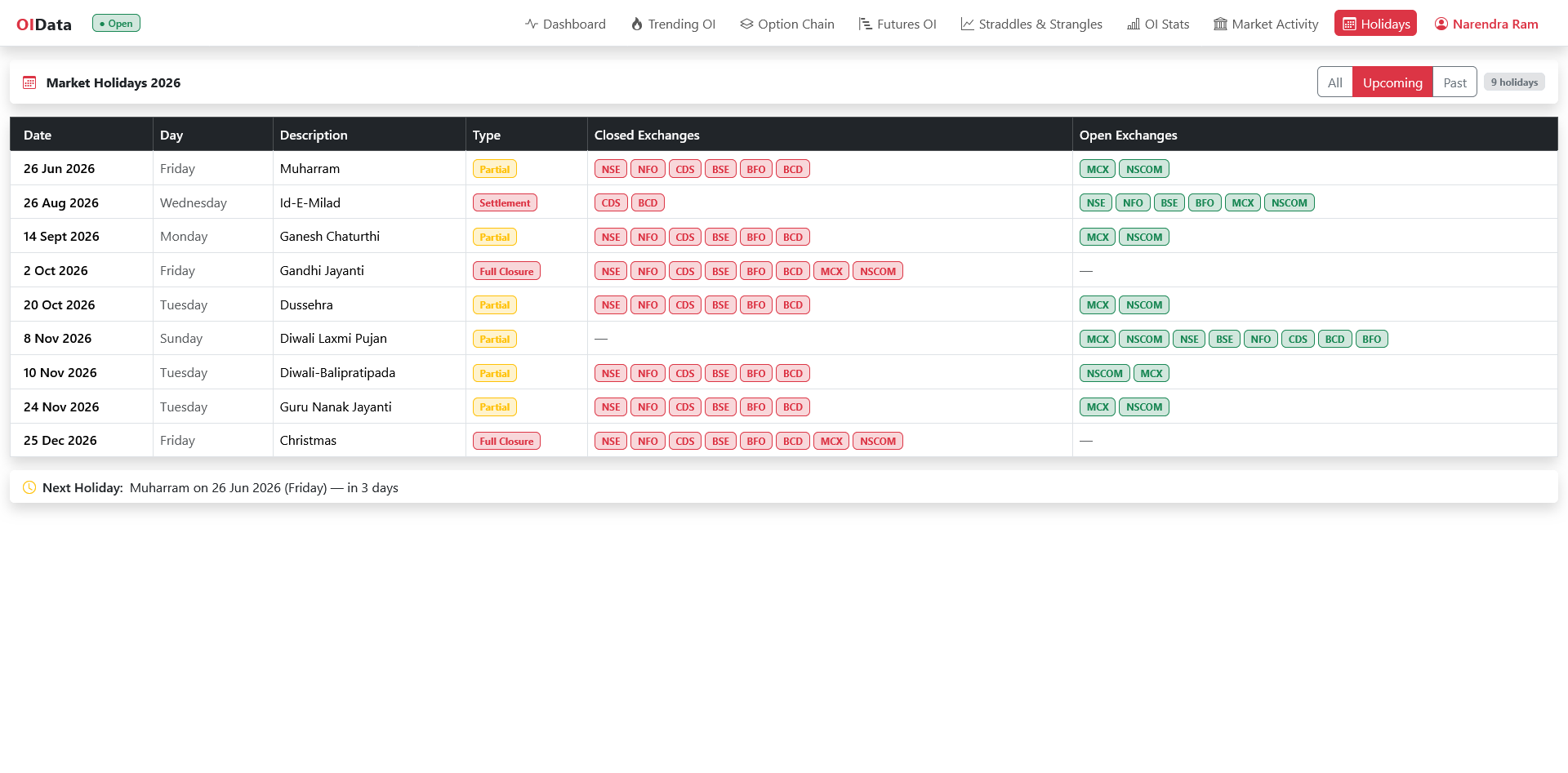
The screenshot shows three genuinely different things sharing one table, which is why the Type column exists.
Full Closure. Everything stops. Gandhi Jayanti on 2 October and Christmas on 25 December show every segment — NSE, NFO, CDS, BSE, BFO, BCD, MCX, NSCOM — in the closed column and nothing in the open one.
Partial. Some segments trade and others do not. Ganesh Chaturthi closes NSE, NFO, CDS, BSE, BFO and BCD while MCX and NSCOM stay open, so commodities trade while equities and equity derivatives do not. If you run positions across both, a partial holiday is a day when one leg can move and the other cannot be adjusted.
Settlement. The oddest and most easily missed. Id-E-Milad on 26 August shows CDS and BCD closed while NSE, NFO, BSE, BFO, MCX and NSCOM stay open. Trading continues; part of the clearing and settlement machinery does not. Currency-derivative positions are the ones affected here, and a settlement holiday shifts pay-in and pay-out obligations without stopping the market.
And then there is the case that catches everyone: Diwali Laxmi Pujan on Sunday 8 November shows nothing in the closed column and every exchange in the open one. That is the Muhurat session — a short, ceremonial trading window on a day the market would otherwise be shut. It is a real session with real settlement, on a Sunday.
What market holidays do to F&O expiry
This is the consequence that costs the most money.
NSE’s rule is straightforward: if the scheduled expiry day is a trading holiday, expiry moves to the previous trading day. It does not move forward, and it does not get skipped.
The knock-on effects are worth spelling out:
- A weekly expiry can land a day early. A position you expected to manage on the scheduled day has already settled. There is no grace period.
- The final session is shorter in calendar terms but not in decay terms. More theta is compressed into fewer sessions.
- Monthly expiry moving pulls rollover with it. The whole rollover window shifts, and the rollover behaviour you would normally see on the Wednesday arrives on the Tuesday.
Because the shift depends on which day the holiday falls on, there is no rule of thumb that substitutes for checking the calendar in a week that contains one. The authoritative list is published by NSE and mirrored on the holidays page.
Long weekends and the cost of nothing happening
Option premium decays on calendar time, not trading time. The market being shut does not pause it.
That produces the most reliable holiday effect there is: a long weekend costs option buyers and pays option writers, before the market has done anything at all. A Friday holiday attached to a normal weekend means three calendar days of decay across one session boundary. An option bought Thursday afternoon and sold Monday morning on an unchanged index has lost money.
Two practical consequences:
Writers price it in, partly. Implied volatility often eases into a long weekend precisely because everyone knows the decay is coming, which mutes the free lunch. The residual edge is real but smaller than the raw theta arithmetic suggests, and it is worth checking against the implied volatility term structure rather than assumed.
Gap risk concentrates. Three or four calendar days of world news arrive at one open. Holiday-shortened weeks are when overnight gaps are widest, and the GIFT NIFTY implied open is most worth reading on the morning after a long closure.
Why market holidays are listed per exchange
The table gives every closure two columns rather than one verdict, and that is not padding. India runs several exchanges on separate calendars: NSE and BSE for equities and equity derivatives, NFO and BFO for their F&O segments, CDS and BCD for currency, MCX and NSCOM for commodities. A date that closes one can leave another trading.
So “is the market closed tomorrow?” is not a well-formed question — the answer depends on which segment your position lives in. Market holidays only become simple once you read them segment by segment, which is why the closed and open lists are shown side by side rather than collapsed into a single yes or no.
A short checklist for a holiday week
- Check the type, not just the date. Full closure, partial, or settlement — they have different consequences, and the badge tells you which.
- Confirm whether expiry moved. If the holiday lands on your expiry day, expiry is the session before.
- Count calendar days, not sessions, when working out decay on anything you are holding through.
- Decide before the close, not after. On a full closure there is no way to adjust once it starts.
- Watch the segment split. On a partial holiday, cross-segment hedges can be stranded.
On OIData
The Market Holidays page carries the full year with the type badge and the exact closed and open segments per date, filters for upcoming and past, and a next-holiday countdown. In a week where expiry has moved, Expiry Day reads from the actual contract expiry rather than the day of the week, and Futures OI shows the rollover shifting with it.
Takeaways
- Market holidays come in three kinds — full closure, partial, and settlement — and only the first stops everything.
- A settlement holiday can leave the market open while clearing is shut.
- If expiry falls on a holiday it moves to the previous trading day, never the next.
- Theta runs on calendar days, so long weekends cost buyers and pay writers.
- Holiday-shortened weeks concentrate gap risk into one open.