Before the Indian market opens each morning, traders glance at one number to gauge the mood: GIFT Nifty. Because it trades for far longer hours than the domestic cash market, it absorbs overnight global news and offers an early hint of where the NIFTY might open. Here’s what it is and how to read it without over-trusting it.
What GIFT Nifty is
GIFT Nifty is a NIFTY futures contract that trades on the NSE International Exchange (NSE IX) at GIFT City, Gandhinagar — India’s international financial services centre. It’s the successor to what traders long called “SGX Nifty”: those Singapore-listed NIFTY futures migrated to GIFT City, consolidating the offshore NIFTY market onto an Indian exchange.
Its defining feature is extended trading hours. GIFT Nifty trades across long sessions that span much of the day and night, so it’s live and reacting while the Indian cash market is closed — through the US session and the Asian morning. That makes it the market’s running scoreboard for NIFTY sentiment outside Indian hours.
From SGX Nifty to GIFT Nifty
For years, offshore NIFTY exposure traded as “SGX Nifty” on the Singapore Exchange, and traders watched it for exactly the same pre-market cue. Following an agreement between NSE and SGX, that liquidity was shifted to the NSE International Exchange at GIFT City and rebranded GIFT Nifty. For the everyday trader the use is unchanged — it’s still the offshore NIFTY futures read on overnight sentiment — but the contracts now sit on an Indian exchange under Indian regulatory oversight, with the volumes that once sat in Singapore consolidated at GIFT City. If you come across older commentary referring to “SGX Nifty,” just read it as today’s GIFT Nifty.
The mechanics: contract specs and trading hours
GIFT Nifty operates under a unique framework designed to bridge domestic and international market hours. Unlike the standard Nifty futures traded on the main NSE platform in Mumbai, GIFT Nifty contracts trade on the NSE International Exchange (NSE IX), which is located in the GIFT City Special Economic Zone (SEZ). Because this zone operates as an offshore financial center within India, these contracts are denominated in US Dollars (USD) rather than Indian Rupees (INR).
The trading hours are divided into two primary sessions that run for a combined total of nearly 21 hours a day, Monday through Friday. The first session starts early in the morning at 6:30 AM IST and runs until 3:40 PM IST, capturing the entire domestic trading session. The second session begins shortly after, from 4:35 PM IST, and extends all the way through the night to 2:45 AM IST the next day. This near-continuous trading window allows international institutional investors to hedge their Indian equity exposure in real-time as economic data releases and geopolitical events unfold in Western markets.
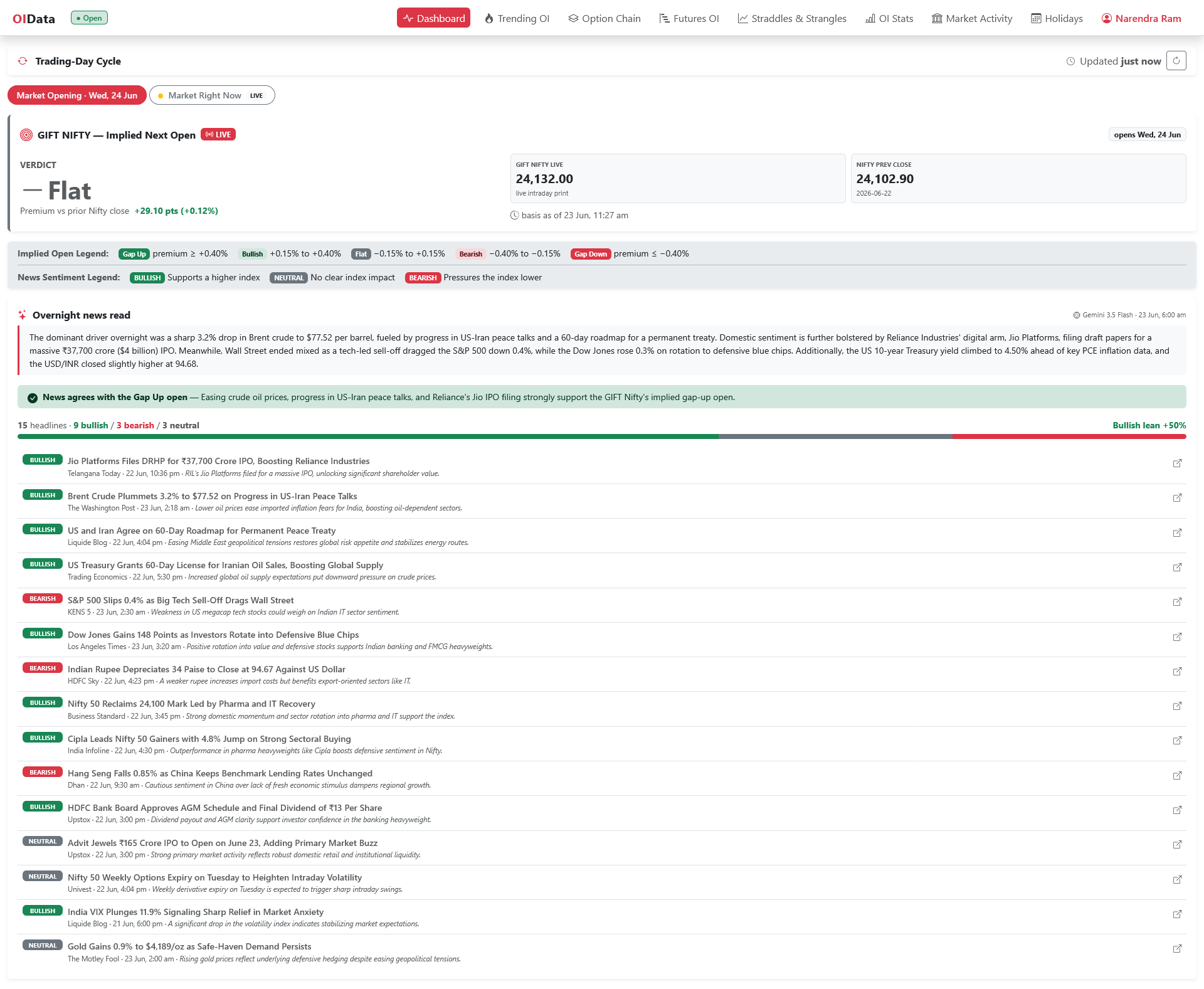
The implied open
Because GIFT Nifty keeps trading overnight, its level just before the Indian open gives an implied open — a rough indication of where the NIFTY may start the day:
- GIFT Nifty trading well above the previous NIFTY close → a gap-up open is implied; overnight cues were positive.
- GIFT Nifty trading below → a gap-down open is implied; overnight cues were negative.
- GIFT Nifty flat → a quiet, unchanged open is likely.
It’s the cleanest single read on how global developments — the US close, crude, the dollar, Asian markets — have shifted sentiment toward Indian equities since yesterday’s close.
How to use it
- Set expectations for the open. Use the implied open to anticipate a gap and plan around it rather than being surprised at 9:15.
- Gauge overnight risk on positions. If you’re holding F&O overnight, GIFT Nifty tells you whether you’re waking up to a tailwind or a headwind.
- Combine with positioning. Read it alongside open interest and FII/DII flows: a gap-up into a heavy call-OI wall may stall, while a gap that aligns with institutional flow has more conviction.
How overnight macro moves it
To make the most of the pre-market indicator, it helps to understand what actually drives the fluctuations in GIFT Nifty while Indian traders are asleep. The overnight movements are primarily reactions to three major global triggers:
- US Market Performance: Major US indices—the S&P 500, Nasdaq, and Dow Jones—usually set the tone for global risk appetite. If Wall Street experiences a sharp sell-off due to unexpected inflation data or hawkish Federal Reserve commentary, GIFT Nifty will immediately reflect this negative sentiment overnight.
- Asian Markets Early Action: Between 6:30 AM IST and 9:00 AM IST, major Asian indices like Japan’s Nikkei 225, South Korea’s Kospi, and Hong Kong’s Hang Seng commence their trading days. GIFT Nifty actively tracks these early morning Asian flows, which often fine-tune the final opening cue for the domestic Nifty.
- Commodity and Currency Fluctuations: Since India is a major importer of crude oil, sharp moves in Brent crude prices overnight can trigger instant reactions in GIFT Nifty. Similarly, sudden swings in the USD-INR exchange rate are quickly priced in by international participants trading the dollar-denominated contracts.
Why the gap can fade (important caveats)
The implied open is an indication, not a guarantee:
- It’s a future, not the index. GIFT Nifty carries a basis (premium or discount to fair value, which is highly influenced by implied volatility), just like any futures contract, so don’t read its level as the exact NIFTY open.
- Gaps get faded. A strong gap-up often sees profit-taking at the open; the first move can reverse. “Gap up then sell off” (and vice versa) is a familiar pattern.
- It reflects sentiment, not depth. Offshore trading can be thinner; a sharp overnight move may not fully carry into the cash session once domestic liquidity arrives.
- Domestic factors still rule the day. Once India opens, local flows, OI walls and news drive price — the overnight cue fades quickly in importance.
Treat GIFT Nifty as the pre-market weather report: useful for knowing whether to carry an umbrella, not a precise forecast of the whole day.
F&O Trading Strategy: Playing the Gap with Open Interest
For options and futures traders, a projected gap-up or gap-down is not just a statistical curiosity—it is an actionable setup. However, trading the opening tick blindly based on the GIFT Nifty cue can be highly risky. Successful F&O players cross-reference the implied open with current derivative data to build high-probability trades.
For instance, if GIFT Nifty suggests a 100-point gap-up, the first step is to analyze the Nifty option chain. Look for heavy concentrations of Call Open Interest (OI) just above the projected opening price. If there is a massive Call OI wall at a strike price close to the gap-up level, writers may aggressively defend their positions. This creates a potential short-term reversal or “gap-fade” opportunity, where the index struggles to sustain its initial gains.
Conversely, if the gap-up breaks clean above a major resistance zone of Call OI, it can trigger a classic short-covering rally. As panicked Call writers buy back their contracts to limit losses, they fuel further upward momentum. Traders who monitor OI buildup types can spot whether the post-open movement is driven by genuine new buying (long buildup) or simply shorts scrambling to cover.
Additionally, if you are running overnight non-directional strategies like straddles or strangles, monitoring GIFT Nifty during the late-night session can help you assess if your break-even points are in danger. If a major global event threatens to push the open far beyond your expected range, you can prepare your adjustment or exit plan before the market opens at 9:15 AM, rather than reacting in a panic during the chaotic opening minutes.
A simple pre-market routine
- Check GIFT Nifty versus yesterday’s NIFTY close for the implied gap.
- Note the overnight drivers (US close, Asian markets, crude, the rupee) behind the move.
- Cross-reference with OI walls near the implied open — is it gapping into resistance or away from support? Finding support & resistance from open interest remains critical here.
- Hold your conclusions loosely — let the first 15–30 minutes of the cash session confirm or reject the cue.
On OIData
The Dashboard surfaces the GIFT-Nifty-implied open alongside the day’s positioning, so your pre-market read sits next to the OI and participant context that actually drives the session.
Related reading
A pre-open gap can be delivered to you rather than watched for — see the GIFT gap rule in open interest alerts — and expected move frames how far the session is priced to travel once it opens.
Takeaways
- GIFT Nifty = NIFTY futures on NSE IX at GIFT City (the successor to SGX Nifty), trading extended hours.
- Its pre-open level gives an implied open — an early read on a gap up/down from overnight global cues.
- Use it to set expectations and gauge overnight risk, alongside OI and FII/DII context.
- It’s an indication, not a guarantee — it’s a future (carries a basis), gaps often fade, and domestic factors take over once India opens. For detailed tips on managing these situations during high-stakes sessions, see our guide on trading expiry days with open interest.