On the morning after expiry, the strike you watched all week is gone. The chain has rolled to the next contract, the terminal’s drop-down no longer lists the old date, and the position that dominated the board for a fortnight has no page anywhere. Expired option contracts are treated as finished business, and for the trader who wants to learn from the market rather than just trade it, that is a loss. A finished strike is the only kind whose story has an ending, and the ending is where the lesson is.
Why expired option contracts disappear
An option contract exists to be settled. On expiry day the exchange settles every open position against the final settlement price, the contract is delisted, and the live data feeds stop carrying it. Terminals and charting apps are built around what can be traded now, so they drop the contract from their lists the same day. The daily record still exists, but nothing on a standard screen offers it to you, which is why looking up expired option contracts usually means a broker data export or a spreadsheet someone kept.
That is a pity, because the contract’s last week is exactly the part you could never fully see while it was alive. During the life of a strike you read it with the outcome unknown. After expiry you can read the same days knowing how they ended, and check whether the signs you would have trusted actually pointed the right way.
What a finished contract can teach
A living strike has a beginning and a middle. A finished one has all three parts, and the third part is where reading skill is built.
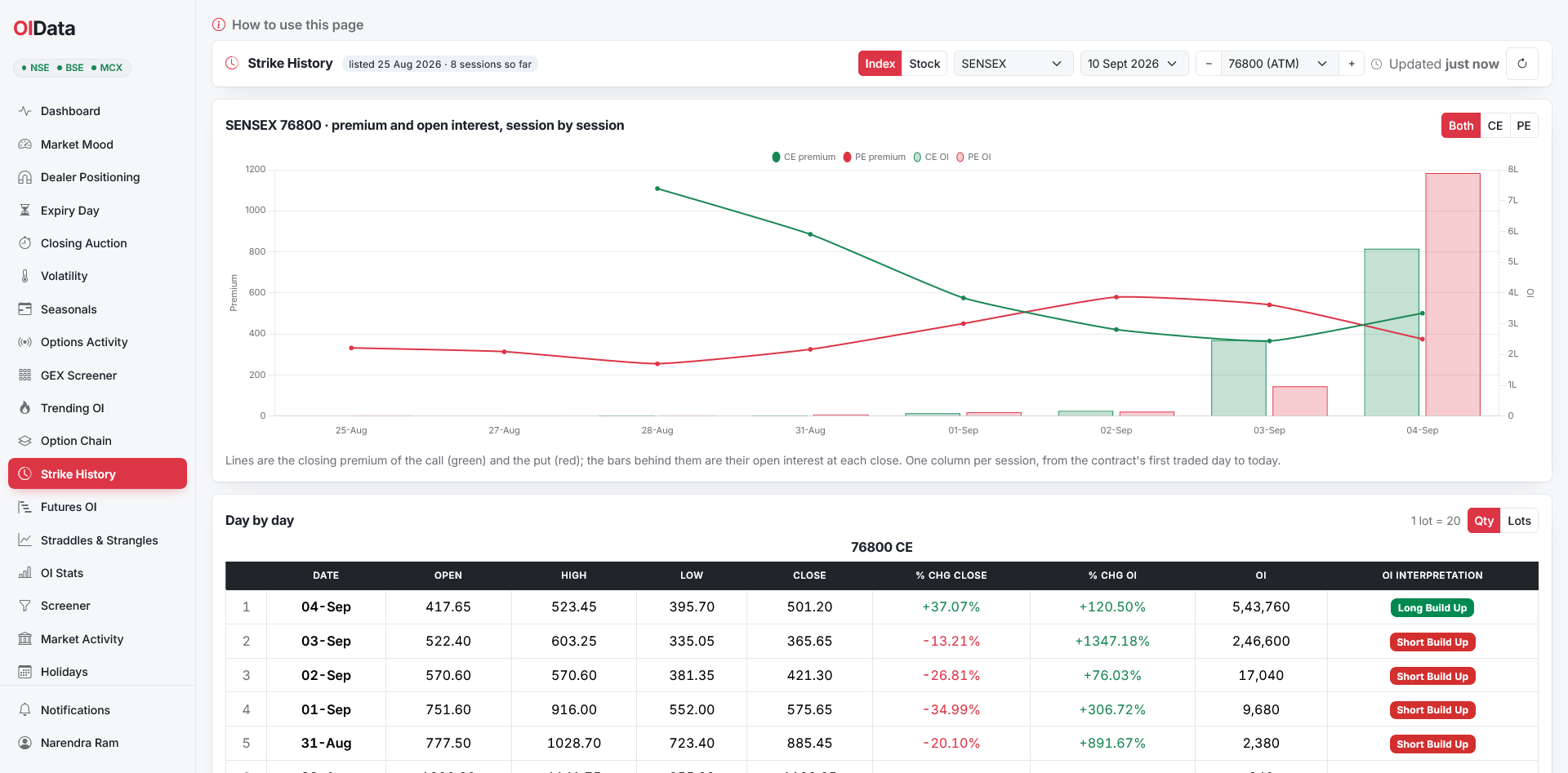
- How the wall was built. Count the sessions of Short Build Up on the heaviest call, see how the premium drifted while the open interest grew, and note whether the position was added a little each day or in one jump. The way open interest builds and unwinds is the same in hindsight as in real time; hindsight just lets you grade it.
- Whether it held. A wall that held shows open interest staying high into the final sessions while the premium collapses toward zero. A wall that broke shows Short Covering rows in the last week, open interest falling as writers buy back, with the premium jumping rather than decaying.
- How the premium decayed. The closing premium of an out-of-the-money strike traces a curve that flattens for weeks and then falls off in the last few sessions. Seeing that curve on several expired option contracts is the fastest way to understand why time works for writers and against buyers, and roughly how fast.
- Where the market settled. Comparing the final settlement level with the heaviest strikes on the chain a week earlier is the honest test of max pain: sometimes the market pins, sometimes it does not, and a dozen finished contracts tell you how often.
Three patterns worth studying
The wall that held. Open interest at a call above spot builds over a week of Short Build Up rows, the market tests the level once or twice, the premium decays to a few rupees and the open interest is still there on the last day. Writers collected the full premium. The lesson is what a defended level looks like before it is defended.
The wall that broke. The same build-up, then two or three sessions of Short Covering with the premium rising sharply and the open interest draining. The market went through, and the writers’ buying back added fuel. The lesson is that the first Short Covering row after a long run of Short Build Up is the moment to pay attention, not the third.
The pinned strike. Both the call and the put at one strike carry heavy open interest, the premiums on both sides decay together, and the settlement lands within a few points of the strike. Reading the put alongside the call is what reveals this pattern; on the call side alone it looks like an ordinary wall.
How to read the last week
In the final sessions the labels change character. Long Unwinding on an out-of-the-money strike is not a signal, it is the normal end of a losing position: buyers accept the loss and the premium goes to nothing. What matters is the open interest, not the label. Open interest that stays high to the last close means positions were carried into settlement; open interest that drains over the last three sessions means the market resolved the level before expiry did. On the final row itself the premium of an out-of-the-money contract should be close to zero and an in-the-money contract should be close to its intrinsic value; a last close far from either is a flag that the strike was still contested at the bell.
Read the expiry-day playbook with a few finished contracts open next to it and its rules stop being abstract.
Where to find expired option contracts
On OIData, the Strike History page keeps expired option contracts for at least six months. The expiry picker has a Listed group and an Expired group; choose a past expiry, pick a strike, and the page shows the call and the put from the contract’s first traded session to its last, with the closing premium drawn over the open interest on one chart and the full day-by-day ledger below, exactly as it does for a live contract. Open interest can be shown in quantity or in lots.
The live option chain only ever shows contracts that can still be traded, which is the right choice for a screen you act on. The history page is where the finished ones live.
For the settlement rules themselves, the regulator’s exchange-traded derivatives framework is the primary source.
Expired option contracts FAQ
Why can I not see a contract after it expires? It has been settled and delisted, so live feeds and trading screens no longer carry it. The daily record exists; it just needs a screen built to show it.
How long are expired option contracts available on the history page? At least six months back. Weekly and monthly expiries are both listed under the Expired group.
Do expired contracts show open interest? Yes. Every session carries the closing open interest and its change from the previous session, along with the premium’s open, high, low and close.
Is studying finished contracts actually useful? It is the only way to check a reading against an outcome. Ten finished strikes read honestly teach more about walls, decay and pinning than a month of watching live ones.
Takeaways
- Expired option contracts hold the one thing a live strike cannot: an ending to check your reading against.
- Study three shapes: the wall that held, the wall that broke, and the pinned strike.
- In the last week, read open interest rather than labels; Long Unwinding at the end is normal, draining open interest is the signal.
- The final close should sit near zero or near intrinsic value; anything else means the strike was still contested.
- Finished contracts are the fastest way to see what premium decay really looks like.