Expiry day doesn’t trade like any other. Time decay goes vertical, option writers tighten their grip, OI levels turn into magnets, and a quiet tape can erupt in minutes. It’s the most popular day for options traders in India—and one of the most dangerous for the unprepared. To navigate that safely you have to read open interest as the day unfolds. Open interest acts as your live map of the battlefield, revealing exactly where big institutional players are defending their positions. By learning to decode these structural F&O shifts, you can identify key support and resistance zones and avoid common trading traps when the clock winds down.
Why expiry day is different
- Theta (time decay) is at its most extreme. With hours left, an option’s time value evaporates fast. Out-of-the-money options bleed toward zero; this is why expiry is prime time for premium sellers. On expiry day, understanding how theta and gamma interact is half the battle.
- Open interest collapses. The expiring series unwinds toward zero as positions settle or roll. Don’t read this mechanical drain as a directional signal — see futures open interest analysis.
- Writers dominate, and they hedge. The big call and put writers defending strikes do most of the steering, and their hedging activity shapes the closing path.
- Gamma risk is real. Near expiry, an option’s delta flips quickly as price crosses a strike. A small move can turn a “safe” short option into a fast loss — the defining danger of expiry for sellers.
OI walls become magnets
On a normal day, heavy open interest marks support and resistance. On expiry, those walls behave even more like pins:
- The strike with the highest call OI is a strong overhead pin; the highest put OI strike is a strong floor. Tracking these concentrated strikes is how you map the day’s expected boundaries.
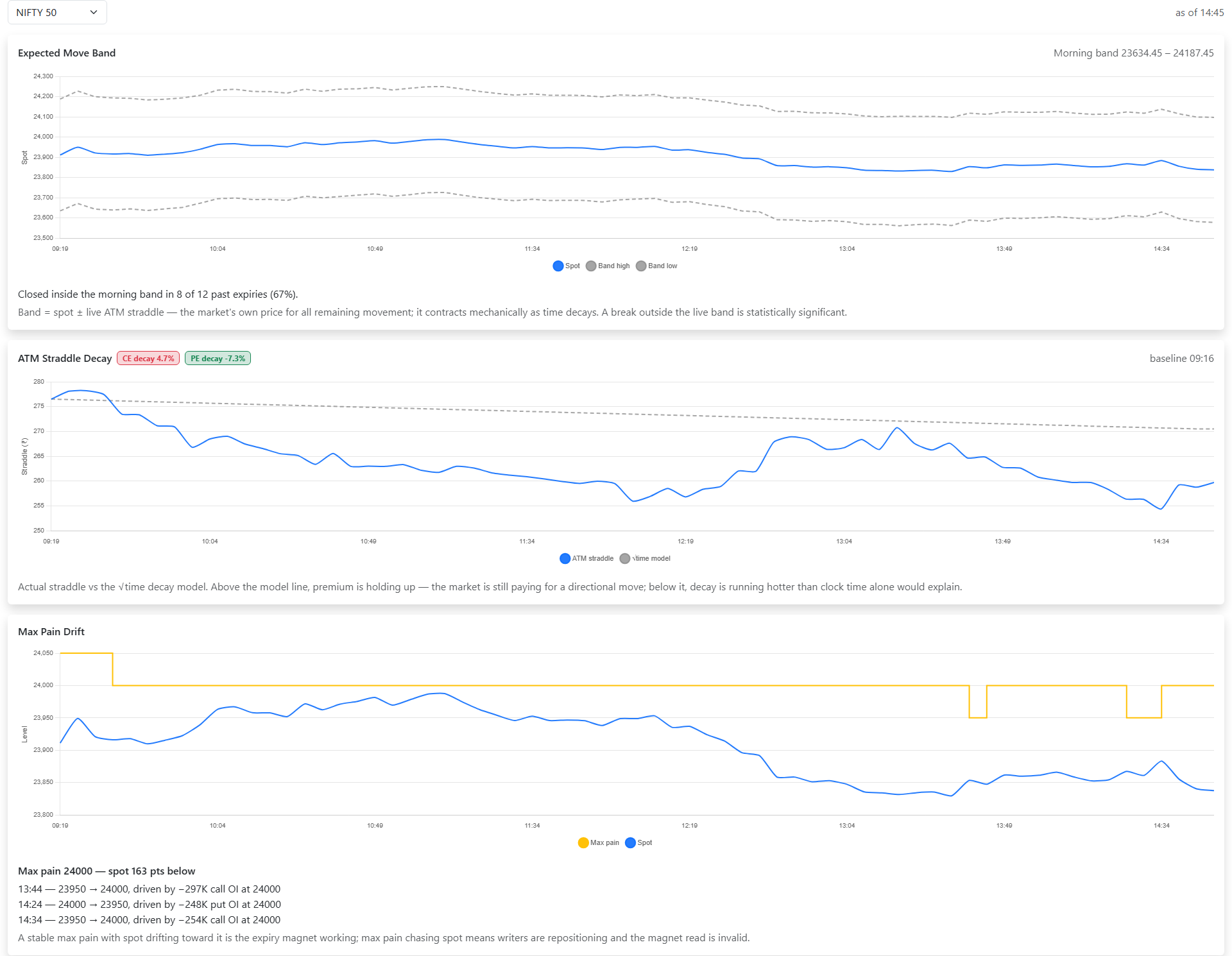
- Price often gravitates toward the level that lets the most options expire worthless — the max pain strike — because writer hedging pulls it there.
- When price sits between two heavy OI strikes with no catalyst, expect chop and pinning rather than a clean trend.
Reading change-in-OI through the day
The live tell on expiry is intraday change in OI:
- OI building at a strike just out of the money → writers are defending that level; it’s likely to cap price.
- OI unwinding rapidly at a wall as price presses it → the defence is breaking; a move through the strike can accelerate as trapped writers hedge in the breakout direction.
- A strike’s OI melting to nothing → routine expiry settlement; don’t over-interpret it.
Pair this with price: a stall at a high-call-OI strike that holds is a pin; a break with that OI collapsing is a genuine move. Watch those live intraday shifts continuously, so you aren’t caught on the wrong side of a squeeze.
Analyzing Live Option Chains for Expiry
All of it rests on reading the option chain in real time. The National Stock Exchange (NSE) publishes live derivative data throughout market hours. You can track these real-time shifts directly on the NSE India Official Website to cross-verify structural data before entering a position.
When you look at the option chain on expiry day, focus on the immediate strikes surrounding the current spot price: - In-the-Money (ITM) Unwinding: If you notice a massive negative change in OI on ITM strikes, it means option sellers are cutting their losses. This short covering often acts as fuel for a rapid directional move. - Out-of-the-Money (OTM) Writing: If premium decay is fast and OTM call/put OI continues to rise, writers are highly confident that the spot price will not cross those levels.
This interplay of spot movement and open interest buildup is the bedrock of any solid expiry strategy.
The Role of Put-Call Ratio (PCR) on Expiry Day
Another metric worth watching on expiry day is the Put-Call Ratio (PCR). The PCR is calculated by dividing the total open interest of put options by the total open interest of call options for a given expiry. - A very high PCR (typically above 1.4 or 1.5) on an intraday basis suggests that the market is heavily oversold or highly bullishly positioned with put writers dominating. - Conversely, a very low PCR (below 0.5 or 0.6) suggests a heavy concentration of call writers, indicating strong bearish sentiment.
On expiry day, the PCR can shift rapidly. If the market is sliding but the PCR starts consolidating and rising at a major support strike, it often indicates aggressive put writing, hinting at a potential short-term bounce. For a deeper dive on how to interpret this ratio without getting trapped, check out our guide on the Put-Call Ratio (PCR) Explained.
Understanding Institutional Footprints through Participant Data
It is equally useful to know who is writing those options. Option writing requires significant capital, which means heavy open interest walls are usually built by Foreign Institutional Investors (FIIs), Domestic Institutional Investors (DIIs), and proprietary desks.
To get a clearer picture of these institutional footprints, you can analyze Pro vs Client Positioning. By understanding whether retail clients are net buyers and institutions are net sellers, you can align your expiry trades with the smart money. When retail traders are heavily long on calls at a specific strike, institutions are often the ones pocketing the premium as those calls expire worthless.
Step-by-Step Execution Plan for Expiry Day
A systematic routine keeps expiry-day risk under control:
- Pre-Market Prep (8:45 AM - 9:00 AM): Identify the key overnight OI walls and find the max pain level. This gives you your initial boundaries.
- The First Hour (9:15 AM - 10:15 AM): Let the initial volatility subside. Do not rush into trades unless you see a clear opening range breakout backed by heavy volume.
- Mid-Day Monitoring (10:15 AM - 1:30 PM): Watch the change in OI. Are the walls shifting closer to the spot price? This is where premium decay is at its most consistent, making it ideal for range-bound non-directional strategies.
- The Post-1:30 PM Regime: This is the high-risk “gamma zone”. If a major OI wall is broken during this window, prepare for a sharp short-covering rally or a panic-selling rout. If you are a premium seller, consider closing your positions early to avoid gamma spikes.
Common expiry-day approaches (and their risks)
- Selling premium (e.g. a short strangle around the OI walls) harvests the fast theta decay. It works most days — until a sharp move blows through a wall and gamma risk produces an outsized loss. Strict stops or protective wings are non-negotiable.
- Playing a breakout of a defended strike can be explosive when a wall finally cracks, but fakeouts are common in the chop.
- Fading a move back toward max pain can work in quiet conditions but fails badly on trend days.
There is no free lunch here: the same theta that makes selling attractive is the mirror of the gamma risk that can hurt you.
A worked expiry-day read
Picture an expiry morning with NIFTY near 22,180, the highest call OI at 22,200, the highest put OI at 22,000, and max pain around 22,100. The map is immediate: a heavy ceiling just overhead at 22,200, a floor at 22,000, and a gentle magnet toward 22,100. With no strong trend, the base case is chop between 22,000 and 22,200, drifting toward 22,100 — conditions that favour premium sellers positioned outside the walls.
The read flips the moment price closes through 22,200 while that call OI unwinds: the ceiling has broken, short calls are under pressure, and the move can accelerate. That single picture gives you both the likely range and the line that invalidates it — which is exactly what you want before risking capital on expiry.
Practical cautions
- Liquidity and spreads. Bid-ask spreads can widen and slippage increases, especially in the final hour. Size accordingly.
- High variance. Expiry is inherently noisy; small edges and tight risk beat big bets.
- Watch the clock. Decay and gamma both intensify into the close — the last hour is a different game from the morning.
- Switch your focus to the next series for any positional view; the expiring series is mostly noise by the afternoon.
On OIData
The Option Chain shows OI and change-in-OI per strike so you can spot the pins and watch the walls hold or break, the Straddles & Strangles page suits premium structures, and the Dashboard keeps the key expiry levels in one view.
Related reading
The structural reason the final session pins is covered in the gamma flip and pin risk, and expected move explains why the band collapses into the close. If expiry lands on a holiday it moves — see market holidays and F&O expiry.
Takeaways
- Expiry day = extreme theta + collapsing OI + gamma risk — its own distinct regime.
- High-OI strikes act as pins/magnets, often dragging price toward max pain.
- Read intraday change-in-OI to see walls defend (pin) or break (accelerate).
- Premium selling harvests fast decay but carries large gamma risk — use stops/wings and respect the high variance of the day.
Read OI through expiry week and you shift from guessing direction to tracking real money flow.
Open InterestOption ChainOpen InterestOpen Interest