Open interest and volume are the two most quoted numbers in F&O — and the two most often confused. They look similar on a screen, both go up and down through the day, and both are “big numbers.” But they answer completely different questions. Getting the distinction right is the difference between a useful read and a misleading one.
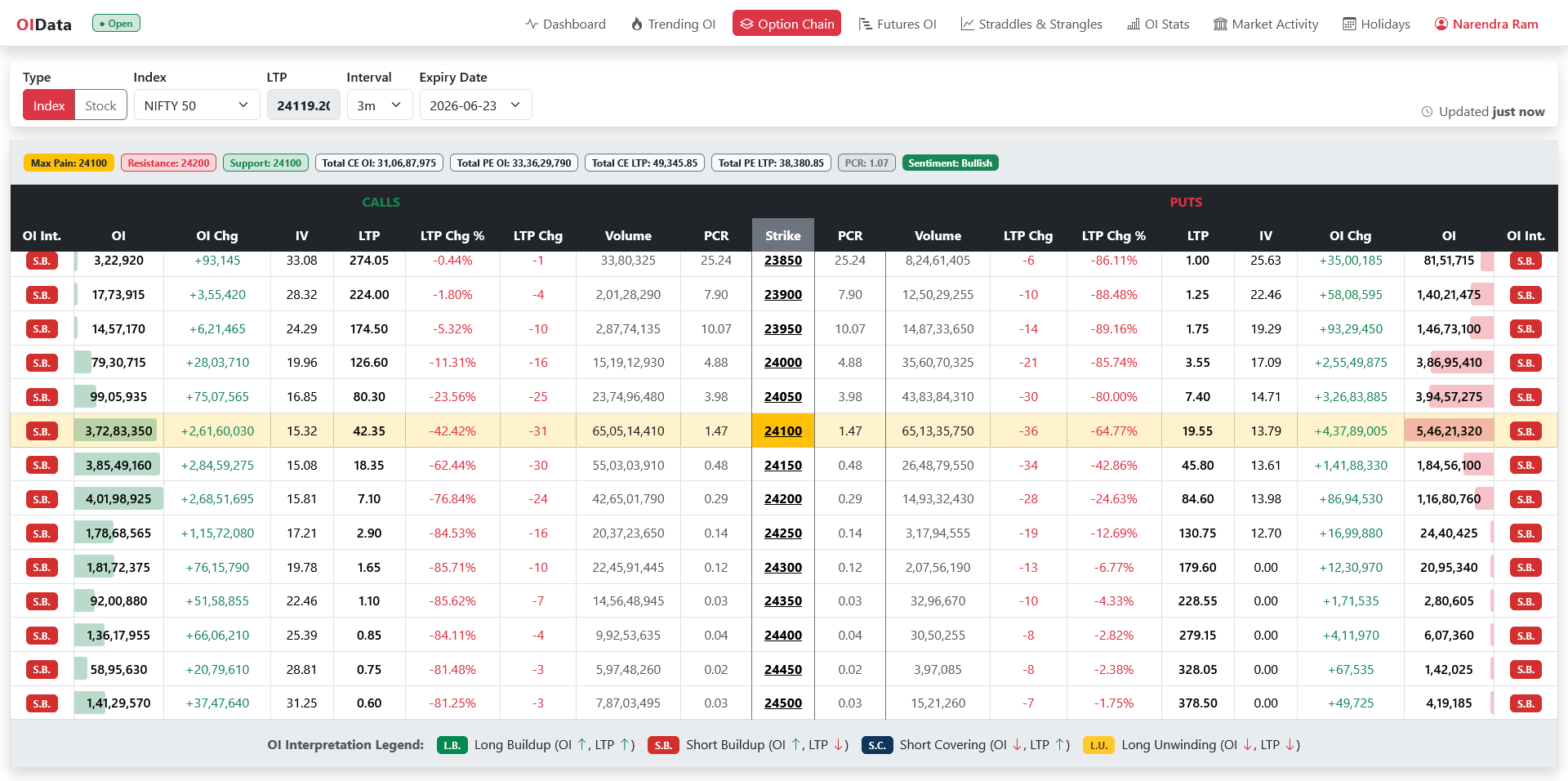
Open interest vs volume: two different questions
- Volume answers: How much trading happened?
- Open interest answers: How many positions are still open?
Volume is a measure of activity over a period. Open interest is a measure of commitment at a point in time. One is a flow; the other is a stock.
Open interest vs volume, side by side
| Volume | Open Interest | |
|---|---|---|
| What it counts | Contracts traded in a period | Contracts still open |
| Resets? | Yes — starts at zero every session | No — carries over day to day |
| A trade between two existing holders | Increases volume | No change to OI |
| Tells you about | Activity, liquidity, interest right now | Money committed, positioning, conviction |
How each one updates
Every time a contract trades, volume goes up — always, no exceptions. It doesn’t matter whether the trade opened a new position, closed an old one, or transferred one between participants. It just counts trades, and it starts fresh at zero each session.
Open interest is choosier. It only moves when the number of open contracts changes:
- New buyer and new seller → OI rises.
- A position changes hands (one side new, one side closing) → OI unchanged.
- A long and a short close against each other → OI falls.
(If that mechanic isn’t second nature yet, the worked example in What Is Open Interest? walks through it step by step.)
A worked open interest vs volume example
Take the same simple sequence and track both numbers:
| Step | Trade | Volume (today) | Open interest |
|---|---|---|---|
| 1 | A buys, B sells (both new) | 1 | 1 |
| 2 | C buys, D sells (both new) | 2 | 2 |
| 3 | A sells to E (A closes, E opens) | 3 | 2 |
| 4 | C sells to D (both close) | 4 | 1 |
By the end, four contracts traded but only one position remains open (OI = 1). Same market, two very different stories — and you need both to understand what happened.
What volume and open interest are good for
Volume is your activity and liquidity gauge. A sudden spike says something is happening here now — news, a breakout, a flush. High transaction counts also mean easier fills and tighter spreads, which matters when you’re choosing which strike to trade.
Open interest is your commitment gauge. Rising OI says new money is taking positions; falling OI says money is leaving. It accumulates, so it reflects the standing bet the market is carrying, not just today’s noise.
Reading open interest vs volume together with price
The real edge comes from reading price, volume and open interest as a trio. A few classic patterns:
| Price | Volume | Open Interest | Common interpretation |
|---|---|---|---|
| Up | Up | Up | Strong uptrend — new longs, fresh money backing the move |
| Up | Up | Down | Short covering — shorts buying back; can fade once it’s done |
| Down | Up | Up | Strong downtrend — fresh shorts being added |
| Down | Up | Down | Long unwinding — longs exiting; selling may ease as it completes |
A move backed by rising activity and rising OI is the most durable, because it’s powered by new participants rather than old ones closing out. A move on rising execution rates but falling OI is often a position-squaring move that runs out of fuel. These price-and-OI combinations are the heart of buildup analysis — see OI Buildup Explained for the full four-quadrant map.
Volume in Indian F&O markets
In the Indian derivative segments, especially for highly liquid indices like Nifty and Bank Nifty, understanding the interplay of these metrics is vital. Trading activity tends to cluster heavily around weekly options expiries, which occur every Thursday for Nifty 50.
Because index options are settled in cash, speculative retail participation drives significant intraday activity. For instance, an active option strike might show an intraday turnover of 50,00,000 contracts, yet its open interest might increase by only 2,00,000 contracts at the end of the day. This indicates that most market participants are scalping or day-trading the momentum rather than carrying positions overnight.
If you are trading stock options, liquidity is much lower compared to index contracts. In stock options, checking the average daily transaction count of a strike is your first line of defense against wide bid-ask spreads. If you enter a high-OI strike with low daily activity, you may find yourself stuck in a trade with no easy way to exit at a fair price.
How NSE reports each one
On the National Stock Exchange of India (NSE), trading statistics are reported in two primary ways: 1. Contract Volume: The total number of option or future contracts traded during the day. 2. Value-Based Turnover: The premium turnover (for options) or the total notional value of the contracts traded.
When analysts discuss the price-to-trade relationship, they are typically referring to contract activity. The NSE updates open interest data continuously throughout the trading session, though the final official figures are computed after market hours. It is critical to monitor how intraday surges line up with these real-time OI shifts to spot institutional blocks or “big money” positioning.
A Real-World Scenario: The RBI Policy Day
To see how this works in practice, imagine a typical RBI Monetary Policy Committee (MPC) announcement day.
- Before the announcement: Bank Nifty is trading flat. Market activity is relatively quiet, but open interest has been steadily climbing over the past three days. This tells us traders are positioning themselves (building up commitment) in anticipation of a big move.
- At 10:00 AM (Announcement): The RBI announces a surprise rate hike. Immediately, the index drops. Trading activity spikes to five times its morning average.
- Analyzing the reaction:
- If the price drops on massive trade counts while open interest surges, it means aggressive new short-sellers are entering the market, driving the index down. This is a highly bearish signal.
- If the price drops on massive activity but open interest plummets, it indicates that previous long-holders are panic-selling and closing out their positions (long unwinding). While painful, this move may quickly run out of sellers once the old longs are completely flushed.
Common open interest vs volume mistakes
- Treating high OI as a “buy” or “sell” signal by itself. It isn’t directional on its own — you need price (and ideally transaction metrics) alongside it.
- Reacting to a huge OI total instead of the change. A large total can be old and stale. The new information is in change in OI — where positions are being added or cut today.
- Forgetting this metric resets daily. Comparing this morning’s trade totals to yesterday’s full-day totals is apples to oranges.
- Ignoring liquidity. A strike with juicy-looking OI but thin liquidity can be hard to exit. Check both.
See it on OIData
- Option Chain shows OI, change-in-OI and trade counts per strike — the three numbers side by side.
- Trending OI highlights where open interest is building or unwinding.
- Futures OI is where the price-activity-OI trio reads most cleanly, away from the extra layer of option writing.
Takeaways
- Volume = activity (a flow that resets daily). Open interest = commitment (a stock that carries over).
- Every trade lifts the metric; only a change in the number of open contracts moves OI.
- Read them with price: rising-price + rising-activity + rising-OI is the strongest combination; moves on falling OI tend to be less durable.
- Watch the change in OI, not just the headline total. Related reading: how to read the option chain shows open interest vs volume per strike, and unusual options activity is what volume gives you that open interest cannot.