The awkward truth about open-interest analysis is that the useful moments are brief and they do not announce themselves. The put wall relocates one strike lower at 11:40. Max pain drifts 150 points across the lunch session. Spot crosses the gamma flip at 2:15 while you are reading something else. Each of those is worth knowing about within minutes, and none of them is worth staring at a screen for six hours to catch.
Open interest alerts solve that specific problem: you describe the condition once, and the server watches for it through the session.
The nine open interest alerts
Each rule is attached to one index — NIFTY, BANKNIFTY or SENSEX — and to a set of parameters. They fall into four groups.
Chain-level sentiment
PCR level cross. Fires when the put-call ratio crosses a level you set, in a direction you choose. Useful precisely because PCR extremes are what matter and the number itself is boring — you want to be told at 1.4, not to watch it travel from 0.9.
OI spike at a strike. Fires when a strike’s open interest jumps by a set percentage inside a window — 5, 10, 15, 30 or 60 minutes. You can restrict it to calls, to puts, or to one specific strike, or leave it open across the chain. This is the closest thing to a “something is happening” alarm.
Max pain and the walls
Max pain shift. Fires when the max pain strike moves at least a set number of points from where it was. The level itself is weak information; the movement is the signal, which makes this a better alert than a dashboard glance.
Spot near OI wall. Fires when price comes within a set percentage of the biggest put or call OI strike. You choose support, resistance or either. This is the alert most people want first — it tells you price is arriving at the level where writers are positioned.
OI wall relocated. Fires when the max-OI wall moves to a different strike, confirmed across two consecutive ticks so a single bad print does not trigger it. A wall moving is writers changing their minds about where they will defend, which is usually more significant than price touching the old wall.
Wall OI unwinding. Fires when the wall’s open interest drops a set percentage from its intraday peak. A wall that is being abandoned stops being support, and this catches that before price finds out. The mechanics of these levels are covered in open interest support and resistance.
Gamma regime
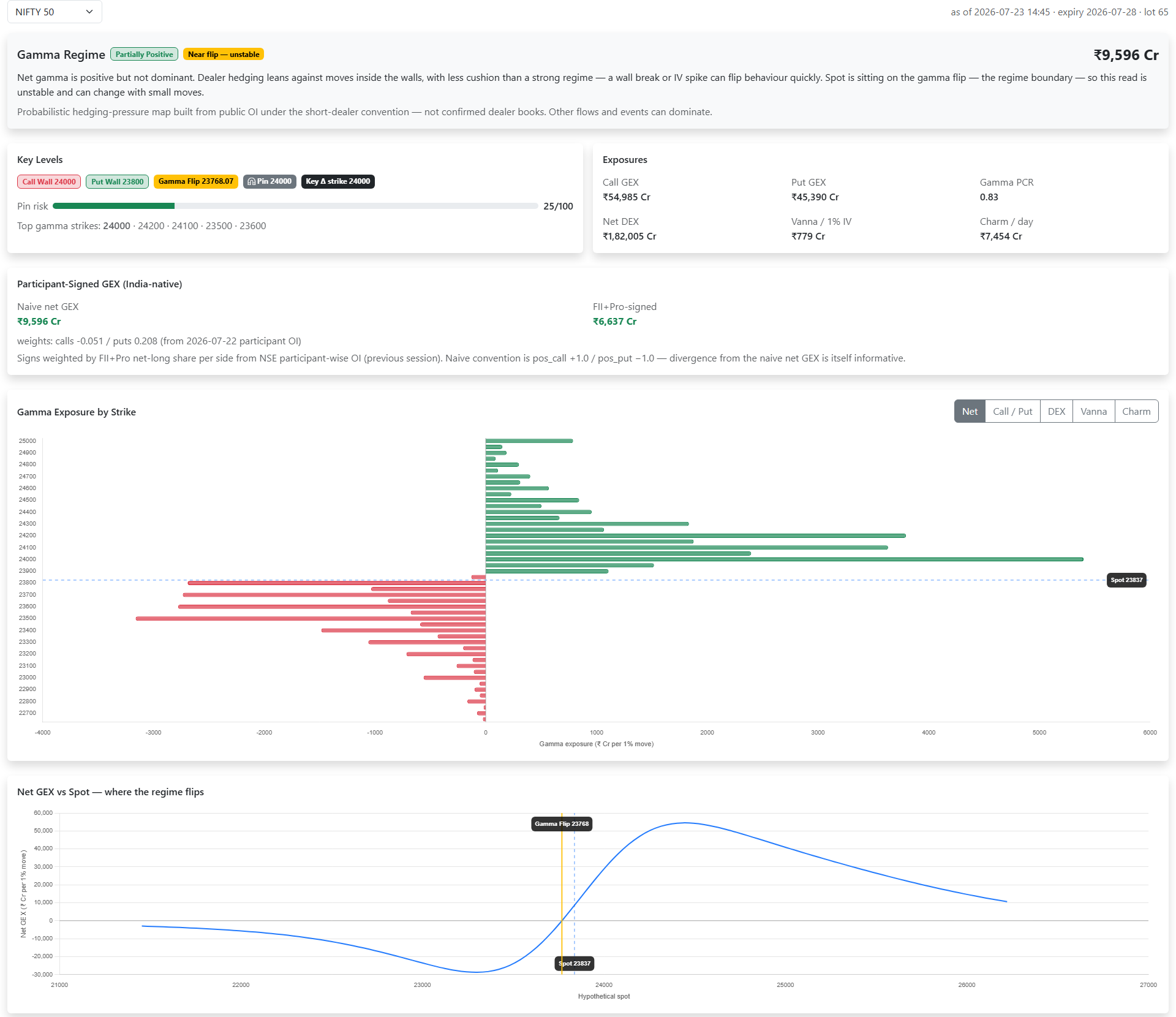
Gamma flip crossed. Fires when spot crosses the zero-gamma level. Since the gamma flip separates a market that dampens moves from one that amplifies them, crossing it is a change in the character of the session.
Gamma regime flipped. Fires when aggregate net gamma changes sign. Related but not identical: spot can cross the flip without the aggregate sign changing, and the aggregate can flip because the chain changed rather than because price moved.
Pre-open
GIFT pre-open gap. Fires before the open when GIFT NIFTY implies a gap of at least the percentage you set. NIFTY only, since there is no GIFT equivalent for the other indices. The reasoning behind that read is in GIFT Nifty and the implied open.
Setting thresholds that survive a real session
Open interest alerts fail in one direction far more often than the other: a rule that fires forty times is worse than no rule at all, because you will start ignoring it. Three things keep the volume sane.
Cooldowns. Every rule carries one — 15 minutes, 30 minutes, 1 hour or 3 hours. After a rule fires it stays quiet for that long. A PCR cross alert without a cooldown will fire repeatedly while the ratio oscillates around your level; with a 30-minute cooldown you get the first cross and then silence. Set the cooldown to roughly how long you would need before the same information would be new to you.
Thresholds wide enough to mean something. The defaults are deliberately not sensitive: 20% OI change over 15 minutes, 100 points of max-pain shift, 0.15% proximity to a wall, 10% wall unwind, 0.5% GIFT gap. For BANKNIFTY, which moves considerably faster than NIFTY, those want widening rather than tightening. Start loose, and tighten only if a rule proves too quiet.
One question per rule. It is tempting to set an OI spike alert across the whole chain at 20% and call it done. In practice you will learn more from two narrow rules — puts only near support, calls only near resistance — than from one broad one, because each firing already carries an interpretation.
What open interest alerts cannot do
They watch data, not markets. A rule fires on a threshold being crossed; it has no view on whether that crossing matters today. A max-pain shift on the Monday of expiry week means something quite different from the same shift on expiry afternoon, and the alert cannot tell them apart.
They are also bounded by the underlying data. Exchange open interest lags the tape by a few minutes, so OI-based alerts inherit that delay — which is why the volume-burst feed is the faster read when speed is what you need. And all of it depends on the exchange publishing on schedule; official derivatives data comes from NSE.
Finally, they fire during market hours on live conditions. They are not backtests, and a rule that would have been useful yesterday tells you nothing about tomorrow.
Delivery
Open interest alerts land in the in-app notification bell by default. Linking Telegram on the Account page adds push delivery, which is the point for most people — an alert you have to open the site to see solves half the problem. Free accounts get one rule; the Ultimate plan raises that to twenty, which is enough to cover both walls, the flip and a PCR level on two indices at once.
Rules can be toggled off without deleting them, and each row shows when it last fired, which is the quickest way to find out that a threshold is too tight or too loose.
On OIData
The Alerts page is where rules are created, enabled and deleted. The conditions read from the same computations as the rest of the app — Option Chain for PCR and the OI walls, OI Stats for the strike distribution, and Dealer Positioning for the flip and regime.
Takeaways
- Open interest alerts cover nine conditions across sentiment, walls, gamma regime and the pre-open gap.
- Wall relocation and unwinding are usually more informative than price touching a wall.
- Cooldowns and deliberately wide thresholds are what keep alerts usable.
- Narrow rules beat broad ones, because each firing arrives with its own meaning.
- Alerts inherit the few-minute lag in exchange OI — use the volume feed when speed matters.