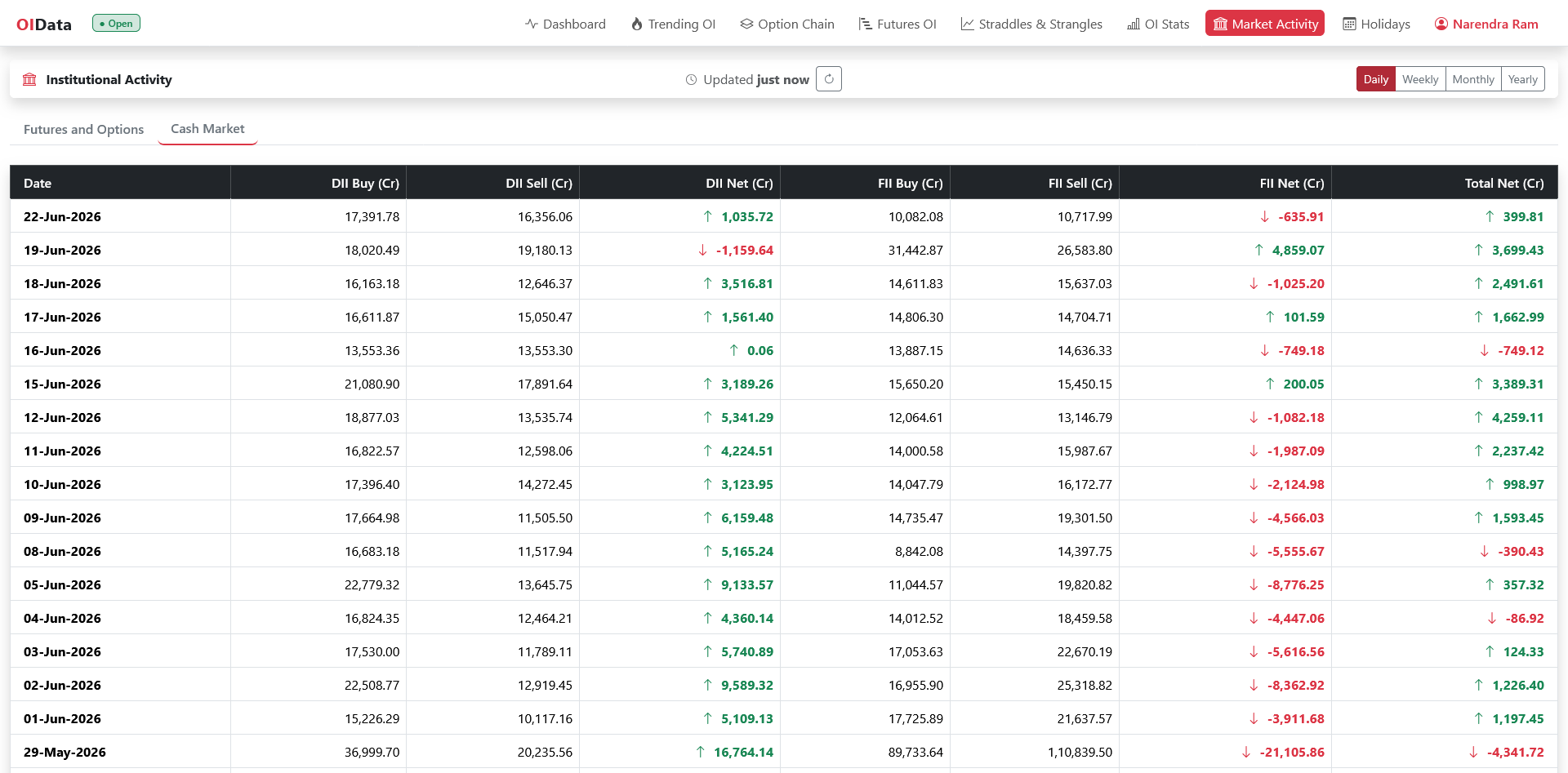
Beyond the headline FII/DII cash figures lies a richer dataset: NSE’s daily participant-wise open interest report. It breaks the entire derivatives market down by who is holding the positions — Client, Pro, FII and DII — and it answers a question price can’t: which group is leaning which way? Used carefully, it is one of the more insightful (and underused) reads available to an Indian options trader.
The four categories
NSE classifies F&O open interest into four participant types:
- Client — the broadest bucket: retail traders, HNIs and other non-institutional, non-proprietary participants. This is “the public,” and it’s the largest group by count.
- Pro — proprietary desks: brokers and trading firms trading their own capital. Typically sophisticated, fast and well-capitalised.
- FII — foreign institutional investors’ derivatives positions (distinct from their cash-market activity in the FII/DII data).
- DII — domestic institutions’ derivatives positions; usually the smallest derivatives footprint of the four.
For each category you can see positioning across index futures, stock futures, index options and stock options — long and short.
Why traders watch Pro and FII
A widely-used (and widely-oversimplified) heuristic says: Clients are often on the losing side, while Pro and FII are the “smart money.” The reasoning is that proprietary desks and foreign institutions have better tools, faster information and stricter risk discipline than the average retail trader, so when their positioning diverges sharply from Clients’, the institutional side is the one to respect.
There’s a grain of truth here — but read the next section before you bet on it. It is also important to note that institutions are often trading in massive sizes. Their footprint in the daily report therefore reflects strategic positioning rather than speculative day trading.
How to read participant-wise open interest
The signal is in net positioning and how it’s changing, not the raw totals:
- Net long vs short by group. Are FIIs net long or net short index futures? Are Pros adding to longs or shorts? Net direction is the headline.
- Divergence between Client and Pro/FII. When Clients are heavily net long while Pro and FII are net short (or vice versa), that disagreement is the interesting bit — it flags which way the informed money is leaning against the crowd.
- Change over time. A shift from net short to net long in the FII index-futures book over several sessions is more meaningful than any single day’s snapshot.
Combine this with the price-and-OI buildup signals: if FIIs are building shorts in index futures and the futures show a short buildup, the two corroborate each other.
Where to get participant-wise open interest
Every trading day after the market closes, the National Stock Exchange of India (NSE) publishes this daily report on its official website. The data is released in a text or CSV format, containing the consolidated positions of all four categories across various contract types.
To download the file manually: 1. Visit the NSE India official portal. 2. Head to the ‘All Reports’ section under the derivatives tab. 3. Locate the “Daily Participant-wise Open Interest” file.
Downloading and parsing those files by hand every day gets old quickly, which is why OIData charts the history for you. Tracking how these numbers evolve over a 5-day or 10-day moving window is far more predictive than looking at a single day’s static snapshot.
Building it into a daily routine
If you want to make this data actionable, you should build a structured post-market analysis routine around it:
- Compare Derivatives with Cash Market Flows: Align the derivatives open interest with the daily cash market FII/DII data. If institutions are buying heavily in cash while simultaneously building long futures positions, it confirms a highly bullish bias.
- Scan for Extremes: Note down the net long-to-short ratios for both FII and Pro categories. When FII net index-futures positioning reaches a historical extreme, the crowd is heavily committed one way — which is when a reversal does the most damage. Treat extremes as a caution flag, not a threshold to trade.
- Analyze Option Writing Zones: Proprietary desks and institutions are heavily capitalized and prefer writing (selling) options to capture time decay. If Pros are net short a large amount of index put options, that marks a support zone the writers are defending — the same open interest support and resistance logic.
- Look for Multi-Day Trends: A single day of heavy retail buying might be noise, but five consecutive days of FIIs accumulating long positions while retail is short-covering suggests a powerful underlying trend.
Myths and caveats — read this before trading it
- “Retail is always wrong” is a myth. Clients are a huge, heterogeneous group; plenty are hedgers, arbitrageurs or skilled traders. Treat the Client bucket as crowd positioning, not a guaranteed fade.
- Hedging muddies the picture. A large institutional “short” in index futures may be a hedge against a cash portfolio, not a directional bearish bet. You usually can’t tell hedging from speculation in the raw numbers.
- One report isn’t a trade. Like all OI data, it’s authoritative end-of-day and describes positioning, not timing.
- Categories shift around expiry as positions roll, which can distort day-to-day comparisons.
The honest framing: participant-wise open interest tells you how the major groups are positioned relative to each other. That’s valuable context, especially at extremes — not a mechanical buy/sell trigger.
A worked example of divergence
Suppose the participant-wise open interest shows Clients heavily net long index futures while FII and Pro are net short — and adding to those shorts over several sessions. The informed money is positioned against the crowd. That doesn’t mean “sell now,” but it’s a caution flag for the bullish Client side. If price then prints a short buildup in the futures, the two readings reinforce a bearish lean and the signal gets stronger. Conversely, when Clients are fearful (net short) while FII and Pro quietly accumulate longs, it can mark a more constructive setup the crowd is missing.
Futures vs options positioning
The cleanest directional read is index futures, where long versus short is unambiguous. In options, a large institutional position might be a spread, a hedge or a writing programme — so net option positioning is murkier and harder to read directionally. When you just want “which way are the big players leaning,” start with index-futures net positions and treat options positioning as supporting colour rather than the headline. If you’re looking to dive deeper into options dynamics, understanding the put-call ratio alongside participant-wise open interest can provide a much clearer picture of market sentiment.
A practical way to use participant-wise open interest
- Check FII and Pro net positioning in index futures — the cleanest directional read.
- Look for divergence against the Client bucket.
- See whether the institutional lean agrees with the futures buildup and price.
- Track the multi-day trend, and weight extremes more than middling readings.
On OIData
The Market Activity page presents FII, DII, Pro and Client positioning together, so you can compare the groups and follow how the informed money is leaning over time — and read it alongside the Futures OI buildup for confirmation.
Related reading
Participant-wise open interest is also what lets a gamma model drop the dealer-sign assumption — see the participant-signed section of gamma exposure explained, which re-signs each side of the chain using participant-wise open interest instead of a convention.
Takeaways
- The report splits F&O open interest into Client, Pro, FII and DII categories.
- Pro (proprietary desks) and FII are watched as informed “smart money”; Client is the broad public.
- The signal is in net positioning, divergence and trend — especially when Pro/FII disagree with Clients.
- Mind the caveats: retail isn’t “always wrong,” institutional shorts may be hedges, and it’s context, not a trigger.