NIFTY and BANK NIFTY are the two most-traded index derivatives in India, and beginners often treat them as interchangeable. They’re not. Their composition, volatility, and the way their open interest behaves differ in ways that matter for every OI read you make. NIFTY and BANK NIFTY are the two most heavily traded index derivatives on the NSE, and their open interest does not behave the same way. Understanding these subtle differences will stop you from applying a standard NIFTY trading mindset to a highly volatile BANK NIFTY chart—a common and costly mistake. Comparing the two lets you calibrate your support, resistance and momentum reads to the index you are actually trading.
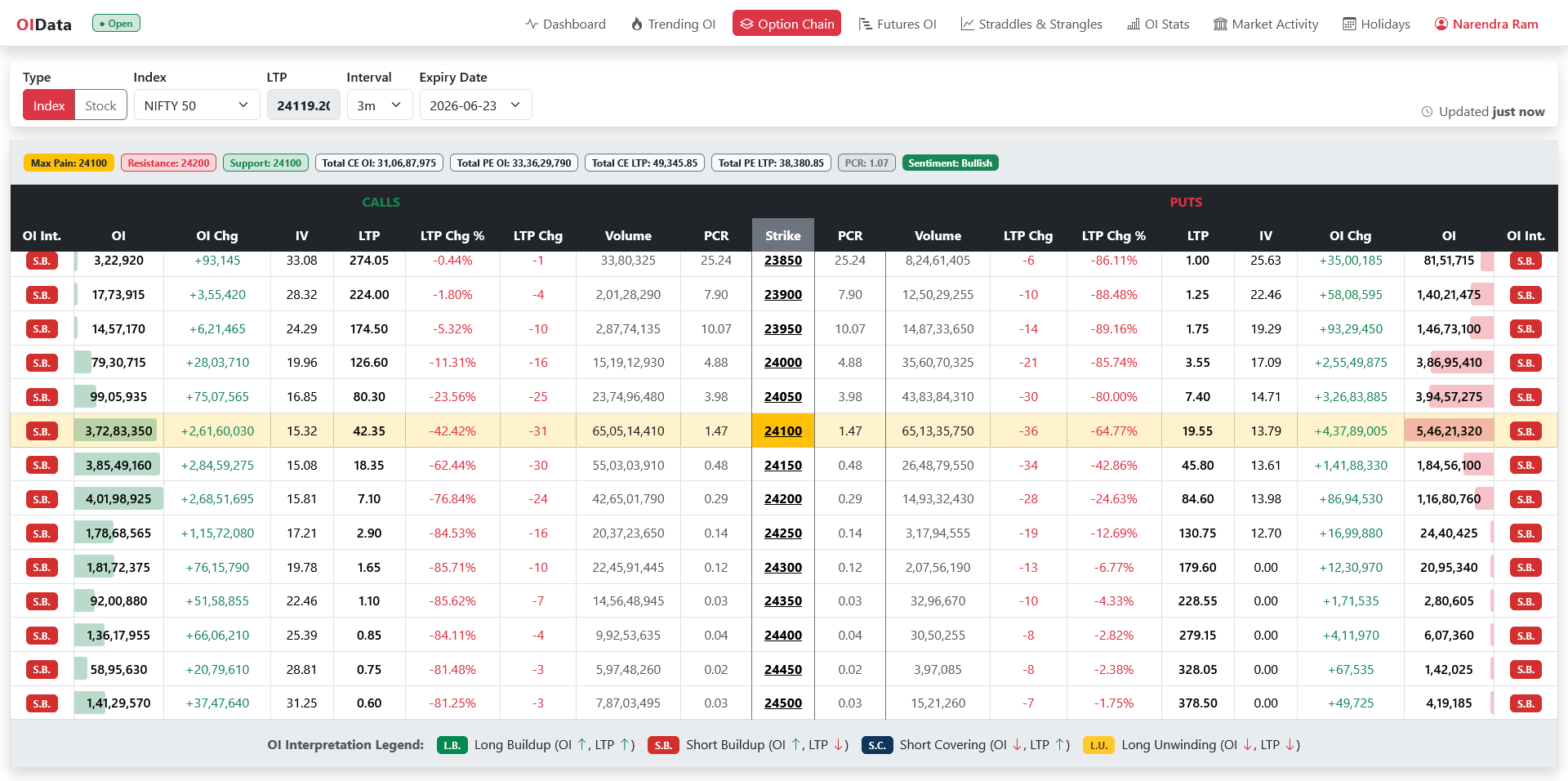
Different baskets, different behaviour
- NIFTY tracks 50 large companies across many sectors — a broad, diversified index. No single stock or sector dominates, so it tends to move in a steadier, more “averaged” way.
- BANK NIFTY tracks a small group of banking stocks, heavily weighted toward a few large private-sector banks. That concentration makes it far more sensitive to banking news, a single heavyweight’s earnings, or a rate decision.
The practical consequence: BANK NIFTY is structurally more volatile than NIFTY. It makes bigger point moves, trends harder, and reverses faster.
What drives the difference
To see why they behave so differently, start with their underlying baskets. NIFTY 50 comprises 50 blue-chip stocks spread across multiple sectors, meaning no single industry dictates its movement. In contrast, BANK NIFTY tracks just 12 banking stocks. This heavy sector-specific concentration means that high-weightage stocks like HDFC Bank or ICICI Bank can single-handedly skew the entire index.
For options traders, this structural difference translates directly into how open interest is written. In NIFTY, option writers (typically institutional players) are more comfortable writing options closer to the spot price because the probability of an overnight 3% gap-up or gap-down is lower. In BANK NIFTY, writers demand a higher margin of safety, clustering heavy open interest at strikes much further away from the spot price. To monitor official contract updates and live weights, you can refer to the official NSE India website.
What that means for open interest
Higher volatility reshapes how OI behaves:
- OI walls break more often in BANK NIFTY. The support and resistance levels that heavy call/put OI creates are more likely to be blown through, because price simply travels further and faster. A NIFTY OI wall is more likely to hold than a BANK NIFTY one.
- Premiums move faster. With higher implied volatility, BANK NIFTY option premiums are larger and swing more, so straddles and strangles behave more violently — bigger profits and bigger losses.
- Buildup signals can flip quicker. A clean OI buildup in BANK NIFTY can reverse to unwinding within a session; NIFTY buildups tend to develop and persist more gradually.
- Wider strike intervals. BANK NIFTY’s larger absolute level and bigger moves mean the meaningful OI clusters sit further apart than on NIFTY.
How expiry days differ
The two diverge most sharply across weekly and monthly expiry cycles. With different expiry days assigned to each index, capital flows and speculative positions shift rapidly. If you are trading expiry day using open interest, you must account for the accelerated rate of premium decay (theta) and sudden price swings (gamma bursts).
During a BANK NIFTY expiry, sudden shifts in the Put-Call Ratio (PCR) can trigger immense short-covering rallies or long-unwinding panics. Because the underlying banking stocks are highly correlated, a breakout in one bank can spark a cascade of stop-losses among option writers across multiple strikes, completely flattening existing OI walls within minutes. In NIFTY, a breakout in IT or FMCG is often cushioned by sluggishness in Auto or Reliance, causing OI levels to degrade far more predictably.
Interpreting Buildup Patterns in Both Indices
When tracking OI buildup, a trader must adjust their filters. A classic long buildup or short buildup signal in NIFTY is usually the result of sustained, institutional block accumulation. It carries high reliability because moving a 50-stock index requires massive, coordinated capital.
Conversely, a sudden spike in BANK NIFTY’s open interest may be nothing more than short-term intraday speculation. Swing traders often utilize the NIFTY and BANK NIFTY option chain to distinguish between genuine trend-building OI and temporary hedging positions. Relying solely on raw OI numbers without factoring in these index-specific structural variations can lead to false breakouts. To manage risk even further, some traders overlay these observations with Max Pain Theory to identify potential pin points near expiry.
NIFTY vs BANK NIFTY side by side
| NIFTY | BANK NIFTY | |
|---|---|---|
| Composition | 50 stocks, diversified | Few banks, concentrated |
| Volatility | Lower, steadier | Higher, faster |
| OI walls | Tend to hold | Break more often |
| Premiums | Calmer | Swing harder |
| Buildup signals | Develop gradually | Can flip within a session |
| Best-suited style | Patient, level-based | Fast, risk-tight |
| Key catalysts | Global cues, FII/DII flows | RBI policy, bank results |
Use this as a quick mental adjustment before you read either chart: the method is identical, but the settings on your judgement should differ.
Reading each one well
For NIFTY:
- OI levels are more reliable; the highest call/put OI strikes frame a range that tends to hold.
- Buildup and PCR reads are steadier and less noisy.
- Better suited to patient, level-based approaches.
For BANK NIFTY:
- Treat OI walls as softer — respect them, but expect breaks and size positions for larger swings.
- Re-read the chain more frequently; the picture changes faster.
- Manage risk more conservatively per trade — the same signal carries more variance.
A note on gap and event sensitivity
Because of its banking concentration, BANK NIFTY reacts sharply to RBI policy, banking-sector news and big private-bank results, often gapping and trending on those catalysts. NIFTY responds to broader cues — global markets, the GIFT Nifty implied open, and FII/DII flows — in a more diffused way. Match your event watch list to the index you’re trading.
Both share the same toolkit — just calibrated differently
The methods don’t change between the two: you still read change-in-OI, buildup, OI walls and PCR. What changes is the calibration — how much weight to give a level, how wide to set expectations, and how tightly to manage risk. BANK NIFTY demands more caution and faster reads; NIFTY rewards patience.
Always confirm current contract specifications, lot sizes and expiry days for each index on NSE, since the exchange revises them from time to time and the two indices don’t always share the same schedule.
Liquidity and trading style
Both indices are highly liquid, but BANK NIFTY’s larger premiums and faster moves attract a more active, short-horizon crowd, while NIFTY’s steadier behaviour suits position trades and level-based setups. If you’re newer to open-interest reading, NIFTY is the gentler place to build the habit — its signals are cleaner and its levels more forgiving — before you take the same toolkit to the faster tape of BANK NIFTY.
On OIData
Both indices are covered across the Option Chain, Trending OI and Futures OI pages, so you can compare their OI behaviour side by side and calibrate your reads to each. Knowing where the two differ lets you trade both with more precision.
Related reading
How far each index is priced to travel is covered in expected move, and the hedging map behind their different personalities in gamma exposure explained.
Takeaways
- NIFTY is broad and steadier; BANK NIFTY is bank-concentrated and more volatile.
- BANK NIFTY OI walls break more often, premiums swing harder, and buildup signals flip faster.
- Read NIFTY with patience and trust its levels more; read BANK NIFTY faster, treat its walls as softer, and manage risk more tightly.
- Same toolkit, different calibration — and always check each index’s current specs on NSE.